How Much Does an Enterprise WordPress Website Cost in 2026?
24 April 2026 •
12 mins read
Search “website development cost UK” and you will find answers ranging from £500 to £500,000. Both numbers are technically correct, which makes them both completely useless. The question everyone types into Google — how much does an enterprise WordPress website cost? — has no honest single answer. It depends on what you are building, who you are building it for, and how long you expect it to last. What we can do is show you the real cost drivers, the budget tiers we see across enterprise projects, and the decisions that push a project from one bracket to another. We have been building enterprise WordPress platforms for over two decades, including sites for JD Wetherspoon, Medivet, and organisations across financial services, publishing, and hospitality. These are the numbers behind that experience.
Why the Price Range Is So Wide (and Why Most Quotes Are Not Comparable)
When an agency quotes £30,000 and another quotes £150,000 for what appears to be the same brief, the problem is rarely that one is overcharging. It is that they are scoping different things. One might include discovery, design, development, content migration, SEO, training, and 12 months of support. The other might cover a theme build with a page template and a handover PDF.
Enterprise WordPress is not a product with a fixed price. It is a service engagement where the scope determines the cost. The variables that move the number most dramatically are the complexity of the design (templated vs fully bespoke), the number and type of integrations (CRM, ERP, SSO, marketing automation, payment gateways), whether the project includes a content migration from another platform, the hosting tier (managed WordPress vs enterprise-grade), and the level of post-launch support included in the agreement. Change any one of these and the cost shifts by tens of thousands of pounds.
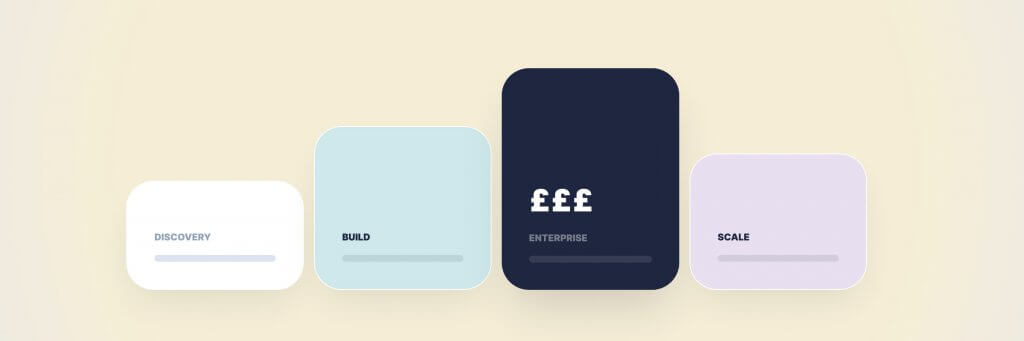
The most productive way to think about enterprise WordPress pricing is not as a single number but as a set of budget tiers — each delivering a different depth of solution for a different type of organisation.
£40,000–£80,000: The Solid Foundation
This is where most mid-market enterprise WordPress projects sit. At this level, you get a bespoke theme built around your brand, a considered information architecture, responsive design across devices, and a clean content management experience for your editorial team. The site will be fast, secure, and built on enterprise hosting from a provider like WP Engine or Kinsta.
A project at this level typically includes a discovery phase (two to three weeks of workshops, stakeholder interviews, and technical scoping), UX wireframing and UI design for key page templates, bespoke theme development using WordPress’s block editor, a handful of integrations — usually a CRM connection, analytics setup, and a forms solution — basic SEO configuration including Yoast setup, metadata, and sitemap generation, editorial training, and a defined handover process.
What this tier usually does not include is content migration from a legacy CMS, complex personalisation, multilingual or multisite architecture, or extensive bespoke plugin development. If your brief includes any of those, you are likely moving into the next bracket. Our guide to discovery and definition explains why scoping these requirements properly before development begins is worth the investment.
£80,000–£150,000: The Full Enterprise Build
This is the range where most of our enterprise projects land. The difference between this tier and the previous one is not quality — it is complexity. Projects here involve more moving parts, more integrations, and more organisational requirements that the platform needs to support.
What Pushes You Into This Tier
Content migration. Moving 1,000+ pages from Sitecore, Optimizely, Drupal, or a bespoke CMS requires automated scripts, manual rebuilds for key landing pages, redirect mapping, and metadata transfer. This alone can add £15,000–£40,000 depending on volume and structural complexity. We have covered the full process in our CMS migration guide and in our specific article on migrating from Sitecore to WordPress.
Multiple integrations. Connecting WordPress to a CRM, marketing automation platform, SSO provider, analytics suite, and one or two additional enterprise systems requires API development, authentication handling, data mapping, and testing across environments. Each integration varies in complexity, but five to ten connections across a project is common at this tier.
Editorial governance. Large organisations need role-based access controls, multi-stage content approval workflows, staging environments for content preview, and structured publishing processes. WordPress supports all of this, but configuring it for an enterprise editorial team with 20 or more contributors requires deliberate architecture and testing.
Personalisation. Serving different content to different visitor segments — by geography, behaviour, referral source, or account status — adds a layer of complexity to both the build and the content strategy. PersonalizeWP, our WordPress personalisation plugin, handles this natively within WordPress, which makes it significantly more cost-effective than bolting on a separate DXP or personalisation platform. But the rules, segments, and content variants still need designing and building.
CMS Migration: The Complete Guide to Moving to WordPress
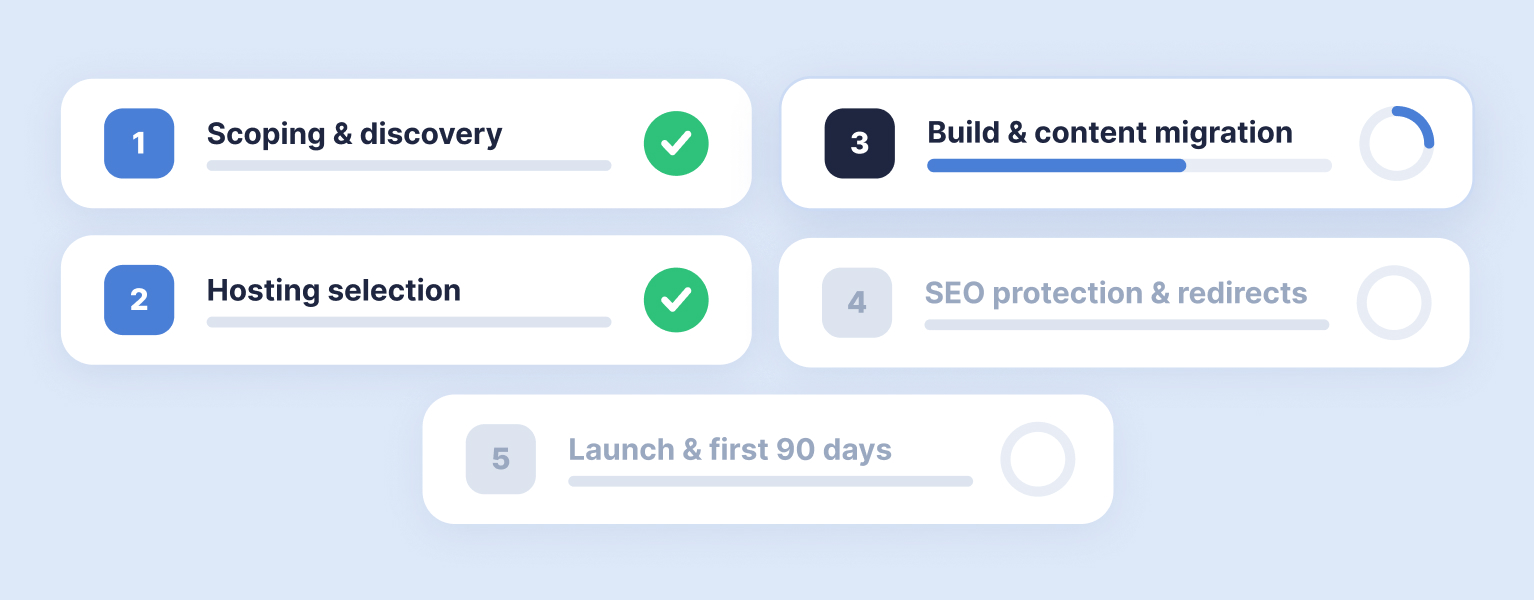
Moving to WordPress from Sitecore, Optimizely, or another platform? Our pillar guide covers every phase — from scoping and hosting selection through to launch strategy and the first 90 days.
£150,000–£300,000+: The Large-Scale Platform
Projects at this level are not websites in the conventional sense. They are digital platforms — multisite networks serving multiple brands or territories, headless WordPress implementations powering mobile apps alongside websites, or large-scale migrations involving thousands of pages of content, dozens of integrations, and significant regulatory or compliance requirements.
At this tier, you are typically looking at WordPress multisite architecture with centralised governance and localised content, enterprise hosting on WordPress VIP (which starts at around £20,000 per year) or WP Engine’s enterprise tier, headless or decoupled WordPress serving content through APIs to multiple front-end applications, complex compliance requirements such as PCI-DSS, ISO 27001, GDPR, or WCAG 2.2 AA across the full platform, multilingual content management across multiple markets, and 15+ system integrations including bespoke middleware development.
These projects run for six to twelve months or more and involve dedicated project management, solution architecture, and ongoing collaboration between the agency team and internal stakeholders. The investment is significant — but it is typically a fraction of the equivalent on Sitecore, Optimizely, or Adobe Experience Manager, where licence fees alone can exceed £100,000 annually before a line of code is written. We have published a detailed cost comparison between Sitecore and WordPress that makes this differential concrete.
Hosting: The Ongoing Cost That Changes the Equation
Build cost is the number that gets all the attention. Hosting cost is the number that determines your three-year total cost of ownership — and it is where WordPress delivers its most compelling financial advantage over proprietary platforms.
Enterprise WordPress hosting from WP Engine starts at around £350 per month for a managed plan suitable for mid-market sites. Their enterprise tier — with dedicated infrastructure, advanced security, and SLA guarantees — is custom-priced but typically runs between £500 and £2,000 per month depending on traffic and complexity. WordPress VIP, the premium option used by newsrooms and large enterprises with the highest security and editorial scale demands, starts at around US$25,000 per year and scales based on monthly unique visitors.
Compare this with Sitecore hosting infrastructure, which typically costs £30,000–£80,000 per year once you account for cloud hosting, dedicated application servers, database servers, and the specialist DevOps required to manage them. Add the licence fee — £40,000–£200,000 per year — and the financial case for WordPress at the enterprise level becomes difficult to argue against.
Filter is a WP Engine strategic partner and WordPress VIP Silver partner. We recommend the hosting tier based on the organisation’s actual requirements — traffic volumes, compliance obligations, editorial workflow complexity, and multi-region needs — not on the hosting provider’s preference. Both platforms suit enterprise workloads, but they serve different points on the complexity spectrum.
What You Will Spend After Launch
A website that is not maintained deteriorates. Plugins become outdated and create security vulnerabilities. WordPress core updates introduce changes that require testing. Hosting configurations drift from optimal as traffic patterns change. Search rankings decline if content stagnates. Performance degrades if nobody is watching the metrics.
Enterprise WordPress sites require ongoing investment in three areas.
Technical Maintenance and Support
Monthly retainers for enterprise WordPress support typically range from £1,500 to £5,000 per month. This covers WordPress core, theme, and plugin updates, security monitoring and patching, uptime monitoring and incident response, performance monitoring and optimisation, and a defined number of development hours for minor enhancements and bug fixes. Retainers at the lower end suit organisations with relatively stable sites and limited change requirements. The higher end is for platforms with frequent content changes, multiple integrations, high traffic, and compliance-driven update cycles.
Content and SEO
An enterprise website is not a brochure you print once and forget. Content needs refreshing, expanding, and optimising for the search landscape — which now includes not just Google but AI search platforms like ChatGPT, Gemini, Perplexity, and Claude. Ongoing content investment varies widely by ambition, but most enterprise organisations allocate between £2,000 and £10,000 per month on combined content production and SEO. Our LLM AI Optimisation Audit assesses how visible your content is across these platforms — a consideration that barely existed two years ago but is now a meaningful component of any enterprise content strategy.
Enhancement and Growth
The best enterprise WordPress sites evolve continuously. New features, new integrations, conversion rate optimisation, personalisation rules, accessibility improvements, and performance tuning all require ongoing development. Many organisations budget a quarterly enhancement sprint — typically £10,000–£25,000 per quarter — to keep the platform aligned with business goals and ahead of competitors.
Seven Things That Drive Cost Up (and Three That Do Not)
Understanding what moves the price is more useful than knowing the price itself. Here is what we see across enterprise projects.
Drives cost up:
Content migration from a legacy CMS. Sitecore, Optimizely, Drupal, and Adobe Experience Manager all store content in structures that do not map cleanly to WordPress. Automated extraction, manual rebuilds, redirect mapping, and metadata transfer add significant scope.
Bespoke integrations. Connecting to proprietary enterprise systems — ERP platforms, bespoke CRMs, legacy booking engines — where no standard plugin or API connector exists requires custom middleware development.
Multisite or multilingual architecture. Managing multiple brands, territories, or languages from a single WordPress installation adds architectural complexity, content governance requirements, and testing across configurations.
Regulatory compliance. PCI-DSS for e-commerce, ISO 27001 for data security, WCAG 2.2 AA for accessibility, sector-specific requirements for financial services or healthcare — each adds documentation, testing, and architectural constraints.
Headless or decoupled architecture. Using WordPress as a content API serving a separate front-end framework adds a full front-end development layer to the project.
Scope uncertainty. Briefs that lack clear requirements generate higher quotes because agencies must price for risk. The more precisely you define what you need, the more competitive and accurate the proposals you receive.
Skipping discovery. Paradoxically, trying to save money by cutting the discovery phase almost always increases the total project cost. Unclear scope leads to change requests, rework, and timeline extensions that cost more than the discovery would have.
Does not drive cost up significantly:
Page count alone. A site with 200 pages using five templates costs roughly the same to build as a site with 500 pages using the same five templates. The complexity is in the templates and content types, not the volume of pages.
WordPress itself. There is no CMS licence fee. WordPress is open-source. This is the single largest cost advantage over every proprietary DXP on the market.
On-site personalisation with PersonalizeWP. Because PersonalizeWP works natively within WordPress, adding personalisation to an enterprise build does not require a separate platform, separate hosting, or separate vendor relationship. It is a fraction of the cost of Sitecore’s or Optimizely’s personalisation modules.
Book a Discovery Workshop
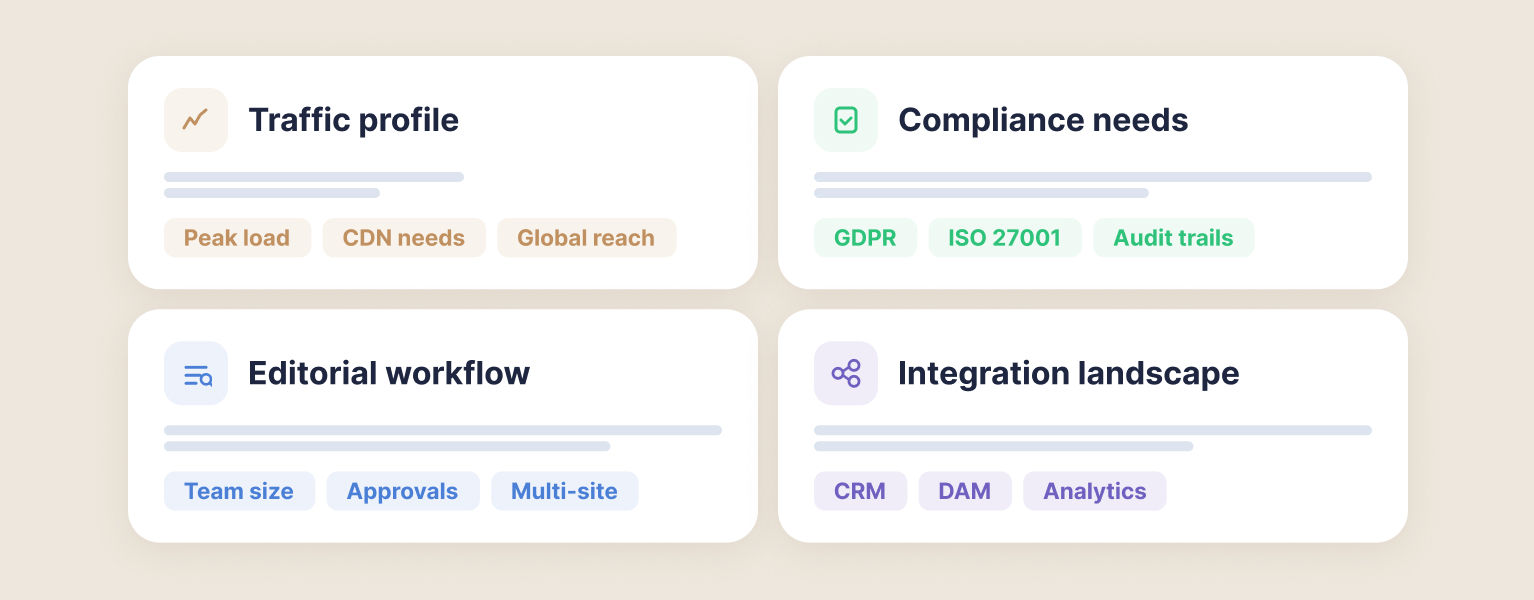
Not sure which hosting platform fits your requirements? Our discovery phase evaluates your traffic profile, compliance needs, editorial workflow, and integration landscape — then recommends the right infrastructure.
How to Compare Agency Quotes Without Losing Your Mind
You will receive proposals that look wildly different for what you believe is the same brief. Before concluding that one agency is overcharging or another is a bargain, check whether they are actually quoting for the same thing.
Does the quote include discovery? A proposal that starts with “we will build you a WordPress site” without a discovery phase is not a cheaper proposal — it is a less informed one. The cost of unscoped requirements will surface later as change requests and timeline extensions.
Does the quote include content migration? If you are moving from another CMS, this is not optional. It is one of the largest workstreams in the project. A quote that omits it is not a lower quote — it is an incomplete one.
What hosting is assumed? A quote built around shared hosting at £20 per month is not comparable to one built around WP Engine or WordPress VIP. The hosting assumption affects performance, security, deployment workflow, and the architecture of the build itself.
What happens after launch? Some agencies price the build and walk away. Others include a transition period, training, documentation, and a defined support retainer. The cheapest build can become the most expensive platform if you are paying emergency rates for post-launch fixes from a different agency six months later.
Who is doing the work? An agency quoting enterprise WordPress development using a team of senior specialists in the UK will price differently from one outsourcing to offshore contractors. Neither is inherently wrong — but the service, communication, and accountability models are different, and the quote should reflect which you are getting.
The Three-Year View: Total Cost of Ownership
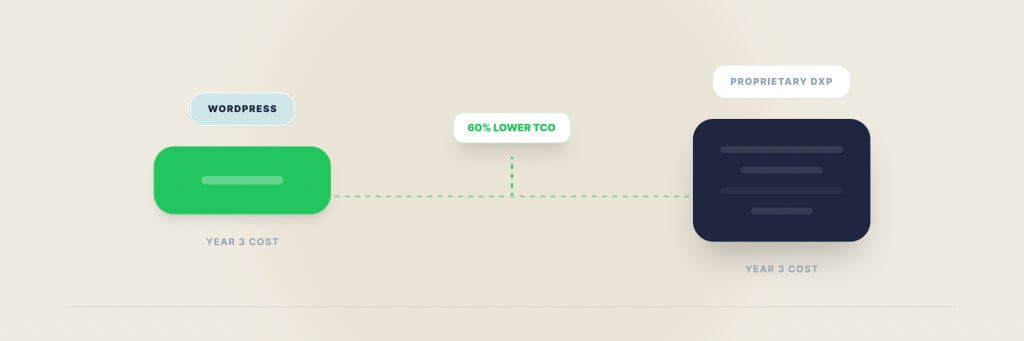
Enterprise technology decisions should never be evaluated on build cost alone. The three-year total cost of ownership (TCO) is the number that matters — and it is where WordPress’s advantage over proprietary platforms becomes most apparent.
Consider a mid-market enterprise project. A WordPress build in the £80,000–£150,000 range, enterprise hosting at £12,000–£24,000 per year, and a support retainer at £3,000 per month puts your three-year TCO between £224,000 and £342,000. That covers the build, three years of hosting, and three years of maintenance and support.
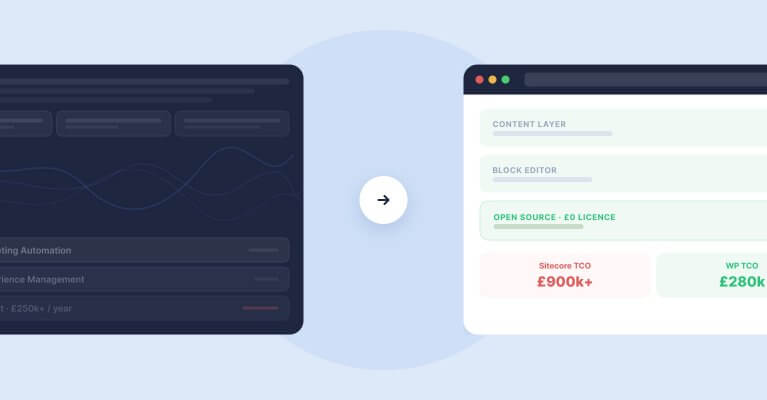
The equivalent on Sitecore — with licence fees of £60,000–£150,000 per year, hosting infrastructure at £30,000–£80,000 per year, specialist development rates, and ongoing maintenance — produces a three-year TCO of £700,000 to £1.5 million. The gap is not marginal. It is structural. And it compounds every year because the licence and hosting costs recur while the initial build cost does not.
Even against other open-source alternatives like Drupal, WordPress tends to deliver a lower TCO at the enterprise level because of the larger talent pool (which keeps development rates competitive), the mature plugin ecosystem (which reduces the need for bespoke development), and the lower barrier to editorial adoption (which reduces training costs and increases time-to-publish).
How We Price Enterprise Projects at Filter
We do not publish a rate card. Every enterprise project is different, and the cost should reflect the specific requirements — not a template applied to every brief. What we do offer is transparency about how we arrive at a number.
Every project begins with a discovery workshop. This is a paid engagement — typically £5,000–£15,000 depending on the complexity of the estate — that produces a detailed scope document, technical architecture, content migration plan (if applicable), and a fixed-price proposal for the build. You know exactly what you are getting, what it costs, and when it will be delivered. No surprises, no change request battles, no “we didn’t realise you needed that” conversations halfway through development.
We have built enterprise WordPress platforms for organisations including JD Wetherspoon, Medivet, and clients across publishing, financial services, hospitality, and retail. Our enterprise WordPress services cover the full lifecycle: strategy, design, development, migration, personalisation through PersonalizeWP, hosting partnership with WP Engine and WordPress VIP, and post-launch support. As WP Engine EMEA Agency Partner of the Year and WordPress VIP Silver partners, we bring the technical capability and the relationships that enterprise projects require.
For organisations also exploring AI visibility, our LLM AI Optimisation Audit can be built into the discovery phase — ensuring your new WordPress platform is structured for visibility across both traditional search and AI search platforms from day one.
If you are at the stage where you need a realistic cost for an enterprise WordPress project, get in touch or book a discovery workshop. We will give you an honest answer — even if that answer is that WordPress is not the right platform for your specific requirements.
Having worked in agencies since he left university, Paul drives both the technical output at Filter, as well as being responsible for planning. His key strengths are quickly understanding client briefs and being able to communicate complex solutions in a clear and simple manner.
Our guide shows digital leaders and development teams how structured data earns AI citations now that systems like ChatGPT and AI Overviews, not rich results, decide visibility.
Download our practical guide to AI and WordPress, covering the new Abilities API, MCP Adapter and AI Client in core, plus how to prepare your platform for the agentic web.
Sitecore to WordPress: What to Expect from the Migration
Your Sitecore contract renewal is approaching and the numbers no longer add up. Before you commit to a migration, here is what actually happens when enterprise teams move from Sitecore to WordPress — the real costs, the content challenges, the SEO risks, and the decisions that separate smooth transitions from expensive false starts.