WordPress VIP vs WP Engine: Choosing the Right Enterprise Host
23 April 2026 •
12 mins read
You have settled on WordPress. The CMS decision is behind you. Now comes a choice that will shape your platform’s performance, security posture, deployment workflow, and total cost of ownership for years: wordpress enterprise hosting. For most enterprise teams, the shortlist comes down to two names — WordPress VIP and WP Engine. Both are managed WordPress platforms. Both serve enterprise clients. Both appear on every comparison list. And yet they are built for fundamentally different organisational profiles. Choosing between them is not a matter of reading feature tables — it is a matter of understanding which platform’s strengths align with your specific constraints. We are partners of both. We have deployed client sites on both. This is the comparison we wish someone had written for us before our first enterprise hosting decision.
What Both Platforms Get Right
Before we get into the differences, it is worth acknowledging why these two platforms dominate the enterprise WordPress conversation. Neither is a budget host dressed up with a premium label. Both provide genuinely enterprise-grade capabilities that separate them from the hundreds of managed WordPress hosts competing for smaller sites.
Both offer global CDN infrastructure, automated backups, staging environments, DDoS protection, and dedicated support teams with WordPress-specific expertise. Both support Git-based deployment workflows. Both deliver sub-second page loads when configured properly. Both have client rosters that include household names across media, retail, financial services, and government.
The overlap is significant — which is exactly why the decision is difficult. The differences are not about one platform being better. They are about each platform being better for a specific set of requirements. The sections that follow are structured around the decision points that actually matter.
Traffic Scale and Infrastructure Architecture
This is where the platforms diverge most visibly.
WordPress VIP runs its own globally distributed infrastructure, purpose-built for sites handling hundreds of millions — even billions — of monthly page views. The architecture auto-scales without intervention. There are no traffic overage fees and no emergency upgrade conversations when a campaign goes viral or a news cycle sends unexpected volume. For publishers, media organisations, and brands whose traffic is inherently unpredictable, this removes a category of operational risk entirely.
WP Engine runs on AWS and Google Cloud Platform infrastructure that scales comfortably to around 100 million monthly visitors on its enterprise tier. For the vast majority of enterprise websites, this is more than sufficient. Traffic beyond that threshold requires custom arrangements. WP Engine’s Global Edge Security, powered by Cloudflare, adds enterprise-grade DDoS mitigation, a WordPress-specific WAF, and Argo Smart Routing — which some customers report improves load times by up to 30%.
The decision point: If your monthly page views regularly exceed 100 million, or if unpredictable traffic spikes are a genuine business risk (not a theoretical one), WordPress VIP’s auto-scaling infrastructure is the safer choice. If your traffic is below that threshold and reasonably predictable, WP Engine’s infrastructure delivers comparable performance at a lower price point.
Security, Compliance, and Code Review
Both platforms take security seriously, but the approach differs in ways that matter for regulated industries.
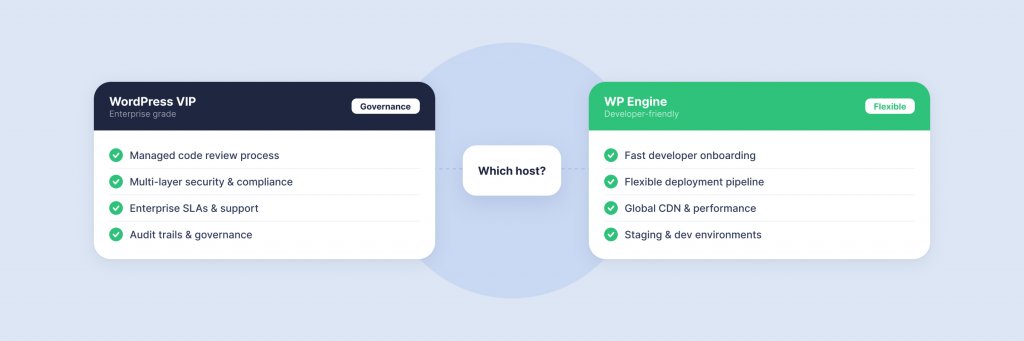
WordPress VIP applies a code review process to every deployment. When code is pushed to the VIP GitHub repository, automated scans from the VIP Code Analysis Bot check for security vulnerabilities, performance issues, and coding standards violations. The platform enforces strict plugin restrictions — only pre-approved or custom-reviewed plugins can run in the VIP environment. Private networking, granular permissions, penetration testing, rapid issue patching, and comprehensive audit logs provide multi-layered protection. Recent enhancements include step-up authentication requiring MFA for sensitive actions like granting user permissions or changing deployment branches.
For organisations operating under regulatory frameworks — financial services under FCA oversight, healthcare under NHS Digital standards, government departments requiring compliance with the Cyber Essentials scheme — VIP’s security model reduces the burden of proving your platform meets the bar. The constraints it imposes are features, not limitations.
WP Engine provides enterprise-grade security through its Global Edge Security package (available as an add-on across all plans): managed WAF with WordPress-specific rulesets, advanced DDoS mitigation across layers 3, 4, and 7, origin IP protection, and automatic SSL. The Smart Plugin Manager automates plugin updates with visual regression testing — if an update breaks something, it rolls back automatically. WP Engine does not enforce code review or restrict plugin usage, which gives development teams significantly more flexibility but places the security responsibility more firmly on the agency or internal team building the site.
The decision point: If your compliance requirements demand auditable code review, restricted plugin environments, and infrastructure-level security controls you do not have to build yourself, WordPress VIP is the more defensible choice. If your development team already has mature security practices and values the flexibility to deploy faster without external review gates, WP Engine gives you that freedom — with strong infrastructure security underneath.
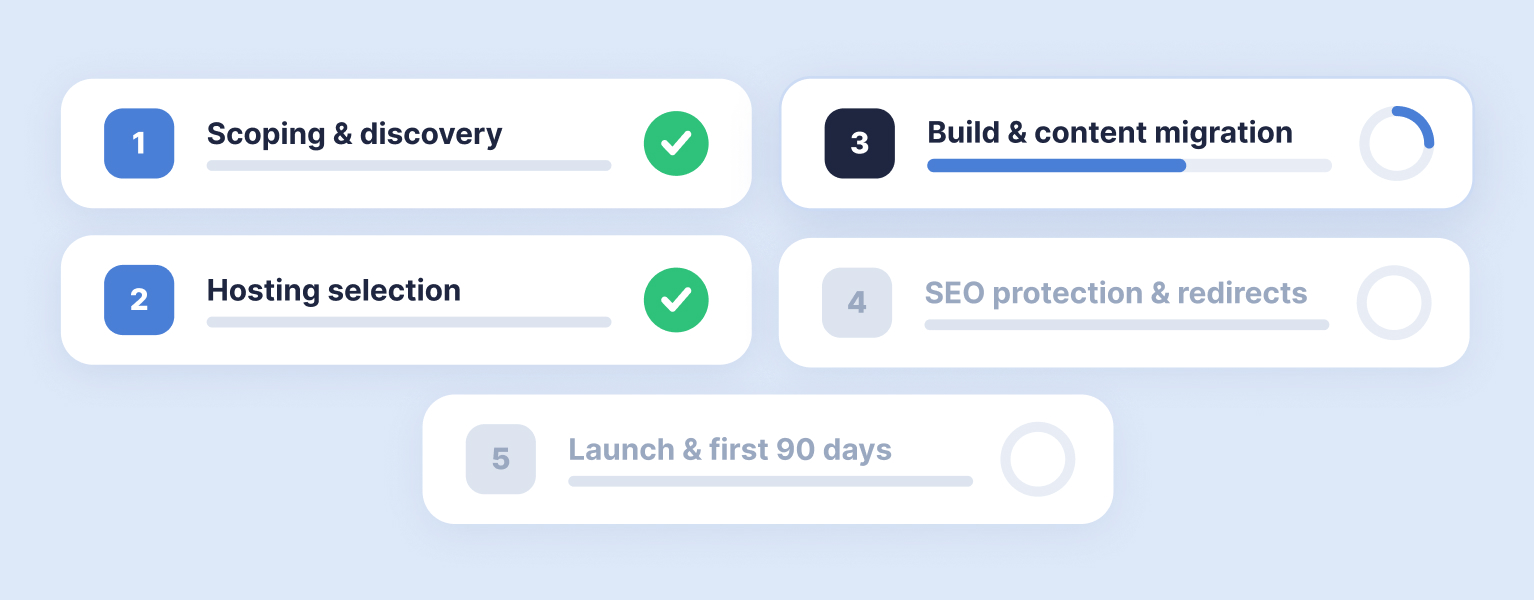
CMS Migration: The Complete Guide to Moving to WordPress
Moving to WordPress from Sitecore, Optimizely, or another platform? Our pillar guide covers every phase — from scoping and hosting selection through to launch strategy and the first 90 days.
Deployment Workflow and Developer Experience
How your development team ships code affects velocity, risk, and day-to-day satisfaction.
WordPress VIP uses a version-controlled GitHub workflow. Each application has its own repository in the wpcomvip GitHub organisation. Developers push code, automated checks run, and deployment to production typically takes a few minutes. You can specify deployment branches, roll back to previous iterations, and create on-demand backups. The discipline this imposes — every change tracked, every deployment auditable — is exactly what enterprise governance teams want to see. The trade-off is speed: the code review and automated scanning add time to the deployment cycle, and the restricted plugin environment means developers occasionally need to build functionality that a freely available plugin would otherwise handle.
WP Engine supports Git push deployments, SFTP, and its own DevKit local development tools. The staging and development environments are one-click affairs. The platform gives developers more freedom — install any plugin, push code without external review, and iterate rapidly. For agencies running multiple client sites, WP Engine’s multi-environment setup and the Smart Plugin Manager make maintenance across a portfolio significantly more efficient. The flip side is that without enforced review gates, code quality and security discipline depend entirely on your team’s internal processes.
The decision point: Teams that value speed, flexibility, and the ability to move fast with minimal gatekeeping will prefer WP Engine. Teams that need — or are required to demonstrate — rigorous deployment governance will find WordPress VIP’s structured workflow an asset rather than an obstacle.
Cost and Budget Reality
This is the section most comparison articles handle badly — either by dodging the numbers entirely or by presenting list prices without context. Here is what the real spend looks like.
WordPress VIP pricing starts at approximately US$25,000 per year (around £20,000) and scales based on monthly traffic, number of WordPress installs, storage, bandwidth, and SLA level. A mid-market enterprise deployment typically runs between US$25,000 and US$60,000 per year. Large-scale deployments with multiple sites, high traffic, and premium support can exceed US$100,000 annually. There are no published tiers — every contract is custom-quoted, which means the price reflects what you actually need rather than forcing you into a bracket.
WP Engine enterprise plans are more granular. The Core WordPress plan starts at around US$480 per month (approximately £5,800 per year). Custom enterprise agreements with dedicated infrastructure, SLA guarantees, and premium support are priced individually but typically fall between £8,000 and £30,000 per year for most enterprise sites. Add-ons like Global Edge Security and Smart Plugin Manager increase the total, but even a fully loaded WP Engine enterprise setup is usually 40–60% less expensive than an equivalent WordPress VIP contract.
That gap is not accidental. WordPress VIP’s pricing reflects its code review infrastructure, stricter environment management, and the operational overhead of maintaining a platform trusted by newsrooms and regulated enterprises. You are paying for the governance layer, not just the servers. WP Engine’s pricing reflects a model where the platform handles infrastructure and the customer (or their agency) handles code quality and security practices. Our article on enterprise WordPress costs breaks down the full three-year TCO calculation, including hosting, support, and ongoing development — where the hosting decision sits alongside the build investment.
The decision point: If your annual hosting budget sits below £15,000, WP Engine’s enterprise tier delivers strong value. If budget is secondary to compliance, governance, and auto-scaling guarantees, WordPress VIP’s premium is justified. Neither is overpriced for what it delivers — but they deliver different things.
Editorial Scale and Multisite Capabilities
Enterprise WordPress rarely means a single site with a single editorial team.
WordPress VIP was built for editorial scale. The platform powers some of the world’s largest publishing operations — newsrooms with hundreds of editors publishing thousands of articles per week. Its multisite implementation is battle-tested at scales most enterprise organisations will never approach. Content workflows, user management, and cross-site governance are core capabilities, not afterthoughts. The VIP Dashboard provides centralised visibility across all sites in the network.
WP Engine supports WordPress multisite and provides tools for managing multiple sites through a single dashboard. For organisations running five to 50 sites — multiple brands, regional variants, or campaign microsites — WP Engine handles this comfortably. The Smart Plugin Manager operates across the portfolio, keeping every site current without manual intervention. Where WP Engine is less suited is the extreme end of editorial scale: organisations with 100+ editors, complex approval hierarchies, and publishing cadences measured in hundreds of pieces per day.
The decision point: If your editorial operation resembles a newsroom — high volume, many contributors, complex workflows — WordPress VIP is built for exactly that. If your organisation publishes at a normal enterprise cadence (weekly articles, quarterly campaigns, occasional product launches), WP Engine provides everything you need without the premium that comes with publishing-scale infrastructure.
Support and Partnership Model
Enterprise hosting is not just infrastructure. It is a relationship.
WordPress VIP provides dedicated technical account management for enterprise clients. Their support team operates at the application layer — they understand your site’s architecture, not just the server it runs on. When issues arise, the VIP team can engage directly with your codebase because they have already reviewed it. This depth of support is valuable when troubleshooting complex problems that span infrastructure and application.
WP Engine provides 24/7 WordPress technical support on all plans, with enterprise clients receiving senior expert assistance and dedicated account management on higher tiers. Their support is infrastructure-focused — they will help with server configuration, caching, CDN issues, and platform-level troubleshooting. Application-level issues (theme bugs, plugin conflicts, custom code) are your agency’s responsibility. The WP Engine solutions engineering team is also available for pre-sales and complex architecture consultations, which we have found valuable when scoping enterprise projects. WP Engine maintains a 99.99% uptime SLA on enterprise plans — just 42 minutes of annual downtime.
The decision point: If you need a hosting partner that will engage with your code and your architecture, WordPress VIP’s application-aware support is a genuine differentiator. If your agency partner handles application-level support and you need responsive, reliable infrastructure support, WP Engine’s model works well — and the 99.99% uptime SLA provides strong assurance.
Book a Discovery Workshop
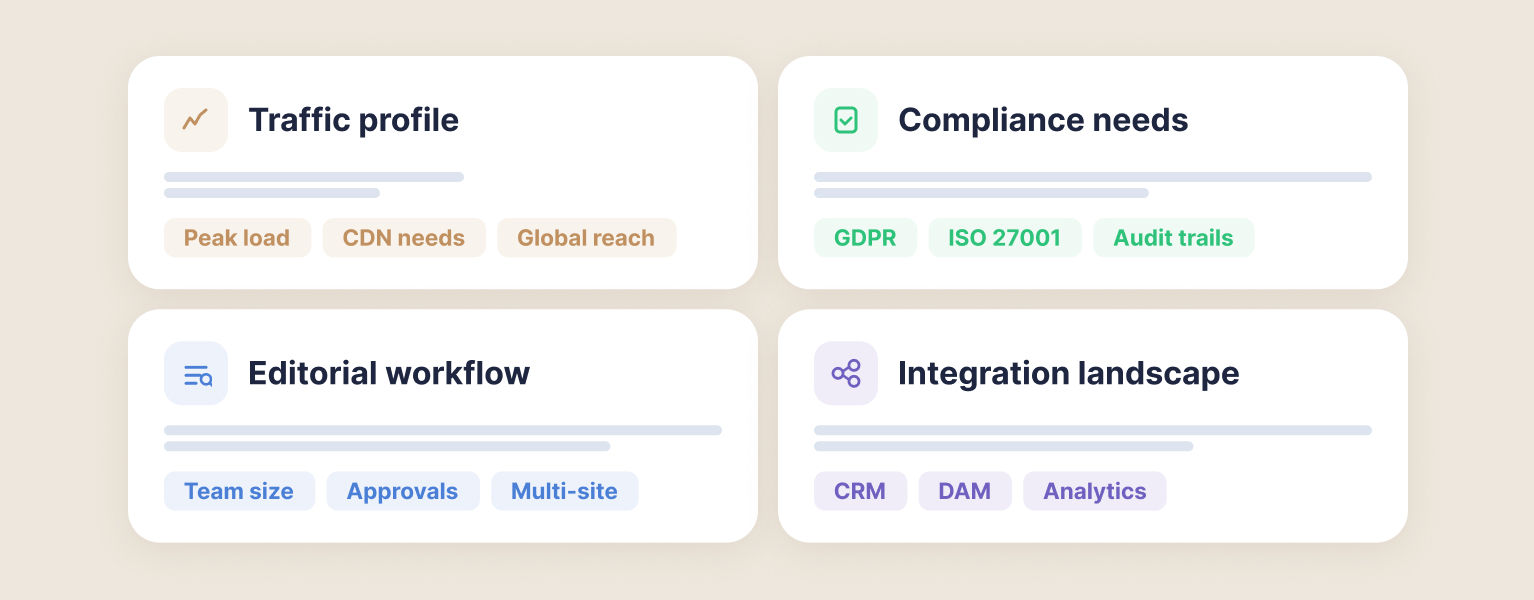
Not sure which hosting platform fits your requirements? Our discovery phase evaluates your traffic profile, compliance needs, editorial workflow, and integration landscape — then recommends the right infrastructure.
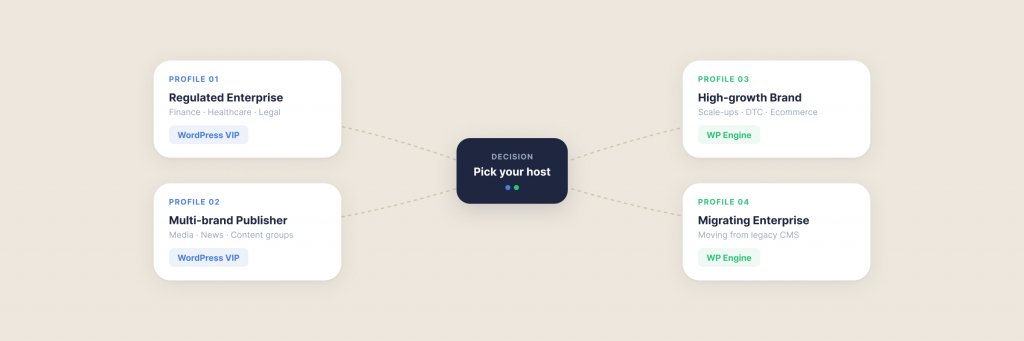
Four Organisational Profiles and Where They Land
Decision frameworks are useful. But sometimes the clearest way to choose is to recognise your own organisation in a description. Here are the profiles we see most often across enterprise hosting decisions.
The Regulated Enterprise
Financial services, healthcare, government, or any organisation where a security incident has regulatory consequences. Compliance teams need to see documented code review processes, restricted environments, and auditable deployment trails. WordPress VIP’s enforced governance model maps directly to these requirements. The cost premium is a fraction of what a compliance failure would cost — and it simplifies every audit conversation.
The High-Growth Mid-Market Brand
Revenue between £10 million and £100 million, a marketing team that publishes regularly but not at media volume, a technology budget that needs to stretch. Traffic is growing but manageable. The priority is performance, reliability, and cost efficiency. WP Engine’s enterprise tier delivers all three, with room to grow. If personalisation is on the roadmap, PersonalizeWP runs natively on WP Engine without requiring a DXP-level hosting commitment.
The Multi-Brand Publisher
Multiple editorial teams, multiple sites, content published at volume throughout the day. Traffic is unpredictable because it follows news cycles, not marketing calendars. This profile needs WordPress VIP — not because WP Engine cannot host the sites, but because the auto-scaling, editorial-grade multisite tools, and application-aware support are worth every penny when you are publishing at this cadence. Downtime during a breaking story is not just inconvenient — it is a competitive loss.
The Enterprise Migrating from a Proprietary CMS
Coming from Sitecore, Optimizely, or Adobe Experience Manager, the hosting decision is part of a larger migration project. The right choice depends on what you are migrating to — not what you are migrating from. If the new WordPress build is a traditional theme-based site with moderate traffic, WP Engine provides excellent value and gets you to market faster. If the migration involves a complex multisite network, stringent compliance requirements, or a headless architecture serving content to multiple platforms, WordPress VIP’s infrastructure earns its place. Our CMS migration guide and Sitecore migration article cover how the hosting decision fits into the wider project.
What About Kinsta, Pantheon, and Other Enterprise Hosts?
WordPress VIP and WP Engine are not the only options. Kinsta runs on Google Cloud Platform and offers excellent performance for mid-market enterprise sites, with a developer-friendly dashboard and competitive pricing. Pantheon provides container-based hosting with strong multi-dev workflows that appeal to agencies managing many sites simultaneously. We are partners of both.
For most enterprise WordPress hosting decisions, WP Engine and WordPress VIP represent the two ends of the spectrum — maximum flexibility and value on one end, maximum governance and scale on the other. Kinsta and Pantheon offer compelling positions in between, and the right choice sometimes lands there. But the decision-making framework is the same: match the platform to your traffic, compliance, editorial, and budget requirements.
How We Approach Hosting Decisions at Filter
We are a WP Engine EMEA Agency Partner of the Year and a WordPress VIP Silver partner. We also work with Kinsta and Pantheon. We say this not to list credentials but to make a point: we have no commercial incentive to steer you toward one platform over another. When we recommend hosting, the recommendation is based on what your project actually needs.
The hosting decision happens during our discovery workshop. We assess traffic volumes and growth projections, compliance and regulatory requirements, editorial team size and publishing workflow, integration complexity and deployment frequency, budget constraints and three-year cost modelling. Then we recommend the platform that serves those requirements — not the platform with the best partner margin.
For organisations exploring how their new WordPress platform will perform across both traditional search and AI search platforms, our LLM AI Optimisation Audit assesses visibility across ChatGPT, Gemini, Perplexity, and Claude — a consideration worth building into any enterprise replatforming project. Hosting architecture affects how efficiently AI crawlers can access and index your content, making the infrastructure decision relevant beyond just page speed.
Our enterprise WordPress services team handles the full lifecycle: discovery, architecture, design, development, hosting configuration, and post-launch support. We have delivered enterprise WordPress platforms for organisations including JD Wetherspoon and Medivet — across WP Engine, WordPress VIP, and other enterprise hosts. If you are weighing up the hosting decision for your next project, get in touch or book a discovery workshop. We will give you an honest recommendation grounded in your actual requirements.
Having worked in agencies since he left university, Paul drives both the technical output at Filter, as well as being responsible for planning. His key strengths are quickly understanding client briefs and being able to communicate complex solutions in a clear and simple manner.
Our guide shows digital leaders and development teams how structured data earns AI citations now that systems like ChatGPT and AI Overviews, not rich results, decide visibility.
Download our practical guide to AI and WordPress, covering the new Abilities API, MCP Adapter and AI Client in core, plus how to prepare your platform for the agentic web.
Sitecore to WordPress: What to Expect from the Migration
Your Sitecore contract renewal is approaching and the numbers no longer add up. Before you commit to a migration, here is what actually happens when enterprise teams move from Sitecore to WordPress — the real costs, the content challenges, the SEO risks, and the decisions that separate smooth transitions from expensive false starts.