The Definitive Guide to Generative Engine Optimisation
23 April 2026 •
17 mins read
Someone opens ChatGPT and asks which enterprise WordPress agencies in the UK are worth speaking to. Three names appear. Yours is not one of them — even though you rank on page one of Google, your domain authority is solid, and your work is genuinely excellent. For that query, in that moment, you were invisible. This is the problem that generative engine optimisation (GEO) addresses. GEO is the discipline of structuring your content, technical foundation, and online presence so that AI search platforms — ChatGPT, Google Gemini, Perplexity, Claude, and Bing Copilot — consistently discover, understand, and cite your website when people ask questions in your space.
Generative engine optimisation is not a rebrand of SEO. It addresses something structurally different — how AI systems retrieve, interpret, and synthesise information to generate answers, rather than how algorithms rank a list of links.
Traditional search works like an index. A user types a query, a search engine matches pages by relevance and authority, and the user sees a ranked list. The goal is ranking position — the higher you sit, the more clicks you receive.
AI search works differently. A user asks a question. The platform retrieves relevant content from across the web, synthesises it, and generates a direct answer — typically citing two to eight sources within the response. The user sees one answer, not ten links. The brands that appear in that answer get recognised. Everyone else is invisible for that query.
GEO is the discipline of making your content, technical infrastructure, and brand signals work within that second model — not in place of traditional SEO, but alongside it. The questions it answers are different: not “will Google rank this page?” but “will ChatGPT, Gemini, or Perplexity cite this content when someone asks a question we should be answering?”
The term itself was formalised in academic research from Princeton, Georgia Tech, and the Allen Institute for AI, which demonstrated that specific content and structural changes could significantly increase the likelihood of content being cited in AI-generated responses. Since then, it has become one of the most consequential emerging disciplines in digital marketing — and one of the least well understood.
Why This Shift Is Happening Now
The numbers make the urgency clear. AI-referred web sessions jumped 527% year-on-year in the first five months of 2025. ChatGPT processes approximately 2.5 billion prompts per day. Google AI Overviews now appear across the majority of informational searches, absorbing attention that previously went to organic listings. Perplexity has surpassed 780 million monthly queries. The scale of this shift is not speculative — it is already visible in referral traffic data for businesses that are tracking it.
These are not minor adjustments to search behaviour. They represent a structural change in where people go for answers — and crucially, how much of that journey ends before anyone visits a website at all. AI-generated answers are designed to resolve queries without requiring a click-through. That means the traditional traffic model — rankings generating clicks generating sessions — is being partially bypassed.
The mechanism at work is Retrieval-Augmented Generation (RAG). When a user submits a query to an AI search platform, the system does not rely solely on training data to generate a response. It retrieves relevant pages from the live web in real time, passes them to a large language model, and uses that retrieved content to construct a grounded, cited answer. This retrieval step is where GEO decisions get made — the platform is filtering, in real time, which sources are accessible, trustworthy, and useful enough to include.
What that means in practice is striking. Some pages that have never ranked in Google’s top ten are cited regularly by AI platforms — because they are clearly structured, directly authoritative, and precisely matched to the question being asked. And some pages sitting comfortably in Google’s top five are absent from AI citations entirely — because they were optimised for a ranking algorithm that measures different signals.
For businesses that have invested in traditional SEO, this is not a reason to abandon that work. It is a reason to extend it — to understand the additional signals AI platforms use, and ensure your content is positioned for both forms of discovery.
How GEO Differs from SEO — and Why Both Matter
The relationship between GEO and SEO is complementary, not competitive. They share common foundations — good content, technical health, and domain authority all contribute to both. But they diverge in three important ways, and treating them as equivalent will leave significant gaps in your visibility strategy.
The first difference is the outcome model. Traditional SEO optimises for position in a ranked list, where visibility is measured by click-through rate and impressions. GEO optimises for inclusion in a synthesised answer, where visibility is measured by citation frequency and brand mention accuracy. A brand sitting in position three on Google and a brand cited in three out of four AI responses to the same query are accessing their audience through completely different mechanisms — and measuring success in completely different ways.
The second difference is the signal set. Google weighs hundreds of factors, with significant weight on link authority, page experience, and keyword relevance. AI platforms weigh a different combination: whether your site is accessible to their specific crawlers, whether your content is structured for extractable answers, whether your brand entity is consistently described across the web, and whether external sources recognise you as authoritative in your topic area. You can score well on one set and poorly on the other — and the gap between them is not obvious until you measure both.
The third difference is measurement. SEO is measured through ranking positions, organic traffic, and CTR — data that has existed in analytics platforms for years. GEO is measured through citation tracking, brand mention frequency across platforms, and AI referral traffic. The tools are newer, the benchmarks are still being established, but the measurement logic is not complicated: you query AI platforms with your target search terms, record whether you appear, and track how that changes over time as you implement improvements.
Neither discipline is optional if search visibility matters to your business. An AI SEO audit will tell you where your current position stands across both — and which gaps to address first.
Free LLM AI Optimisation Audit
See how your website performs across ChatGPT, Gemini, Claude, Perplexity, and AI Overviews. Free, instant, and based on 90+ ranking factors.
The Signals That Make Content Visible in AI Search
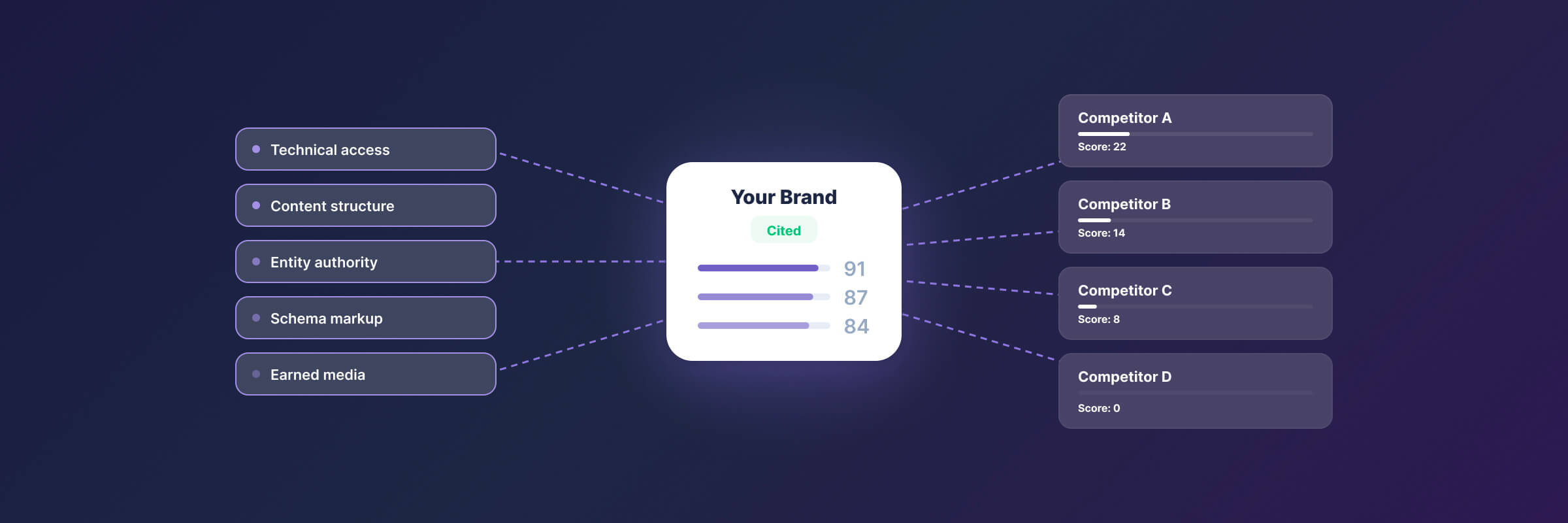
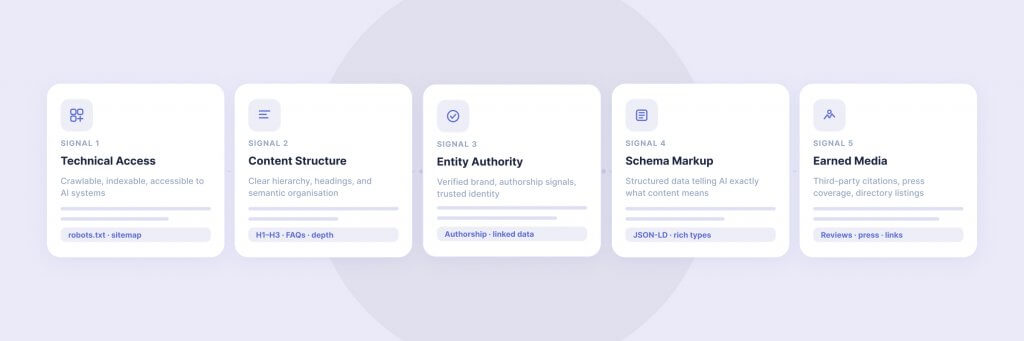
What determines whether an AI platform discovers, trusts, and cites your content? There are five connected signal areas. Each one matters independently, and weakness in any of them creates gaps even when the others are strong.
Technical Access
Before AI platforms can cite your content, they need to be able to reach it. The major AI search platforms each deploy their own crawlers: GPTBot for ChatGPT, Google-Extended for Gemini and AI Overviews, PerplexityBot, ClaudeBot, and OAI-SearchBot. If any of these are blocked — even unintentionally, through a catch-all robots.txt rule or a WAF configuration that challenges unfamiliar bot user agents — those platforms cannot index your pages at all.
It is more common than you might expect. A blanket Disallow: / rule added during a security configuration review years ago, or a Cloudflare setting tuned to block traffic flagged as bot-like, can silently exclude entire platforms. We surface this issue regularly in our LLM AI Optimisation Audit. It is the first thing to check, and it is a quick fix with immediate impact.
The newer llms.txt standard — a protocol similar to robots.txt but designed specifically for AI platforms — allows you to signal which content you want AI systems to prioritise. It is not yet universally adopted, but implementing it is low-effort and demonstrates to AI crawlers that you are actively managing your content preferences.
Content Structure and Answer Clarity
AI platforms retrieve content and make rapid judgements about whether it is useful enough to cite. That decision is heavily influenced by whether your content answers the target question directly and early — within the first 300 words — and whether the structure makes information easy to extract.
Content written for linear reading — long narrative paragraphs, buried conclusions, academic hedging — is harder for AI to work with. Content written with specific assertions, direct answers, clear section headings, and well-defined terminology gives AI platforms the signals they need to attribute information accurately to your source.
The original GEO research from Princeton, Georgia Tech, and the Allen Institute for AI found that including citations, statistics, and clearly structured answers can increase AI citation rates by more than 40%. That is a significant uplift from changes that require no additional content creation — just better organisation of what you already have.
Entity Authority and Brand Signals
AI platforms are not just evaluating individual pages. They are evaluating whether your brand entity is consistently and credibly represented across the web. This means: is your organisation described consistently on your own website, in your Google Business Profile, on LinkedIn, in Crunchbase, and in third-party directories? Are your authors identified with biographical credentials? Do credible external sources reference your content or mention your brand by name?
Entity authority is the longest play in GEO — it builds slowly through consistent publishing, earned recognition, and genuine topical depth. But it compounds. A brand that has established strong entity signals across its sector will be cited more reliably across AI platforms, even for queries that don’t precisely match any individual page it has published.
Schema and Structured Data
Schema markup gives AI platforms explicit, machine-readable context about your content — who wrote it, when it was published, what type of content it is, and what questions it answers. Pages with comprehensive Schema.org implementation are retrieved more reliably in AI-generated answers.
Article schema belongs on all content pages. Organisation schema establishes your brand entity on your homepage. FAQPage schema flags Q&A content as directly answerable. HowTo schema marks up step-by-step guides. The value of schema is not that AI platforms read it exclusively — it is that it resolves ambiguity. When markup clearly states who wrote something, what it covers, and which organisation produced it, the AI’s interpretive burden is reduced and accurate citation becomes more likely.
On WordPress, tools like Yoast SEO handle the basics automatically. For complex sites with custom content types, bespoke schema implementation tends to produce better results — particularly for services businesses where the standard Article schema may not fully represent the content being published.
Earned Media and External References
AI platforms exhibit a systematic preference for content that has already been recognised as authoritative by others. Third-party citations, press coverage, sector directory listings, and links from credible sources all contribute to GEO visibility — in ways that go beyond traditional domain authority and speak directly to how AI systems assess trustworthiness.
For businesses in competitive sectors, earned media is often the differentiating factor. Two websites with similar technical setups and content quality can produce very different GEO outcomes if one has been meaningfully cited by sector publications, industry research, or recognised institutions and the other has not. Building this recognition takes time — but it is the signal that is hardest for competitors to replicate quickly.
How AI Search Actually Works
To understand why all five signal areas matter, it helps to understand the mechanism behind AI search responses.
Most major AI search platforms use a process called Retrieval-Augmented Generation. When a user submits a query, the system does not generate a response purely from training data. Instead, it retrieves relevant documents from the live web, passes those documents to a large language model, and uses them to construct a grounded, cited response. The model synthesises the retrieved content into an answer and attributes information to specific sources.
The retrieval step is where GEO happens. The platform is making real-time decisions: which pages are accessible to its crawler? Which content is structured clearly enough to extract useful information from? Which sources carry enough authority to be worth citing in the final response? Pages that pass these filters get used. Pages that don’t — regardless of their Google ranking — remain invisible for that query.
This is why GEO cannot be reduced to writing better content. Excellent content that is blocked by a robots.txt rule will never be retrieved. Well-written content without schema or entity signals will be retrieved less reliably. And high-quality content from an organisation without established external recognition will be deprioritised in favour of sources the model has encountered and trusted across multiple contexts.
The practical implication: every significant piece of content you publish should be evaluated against all five signal areas before it goes live — not just for writing quality, but for technical access, structural clarity, schema implementation, and entity alignment.
Five Questions to Test Your GEO Readiness
Before investing in new content or technical work, it is worth understanding your current position. These five questions cut through to the areas that matter most — and each one has a concrete answer you can find today.
Can AI Crawlers Actually Reach Your Website?
Download your robots.txt file and check for rules that block GPTBot, Google-Extended, PerplexityBot, or ClaudeBot. Then check your WAF and CDN configuration — Cloudflare in particular can be set to challenge or block traffic from unfamiliar bot user agents. This is the single highest-impact check and the most common problem we find in audits. A site that is otherwise well-optimised for GEO will produce zero AI citations if its crawlers cannot access the content.
Does Your Most Important Content Answer the Question Within 300 Words?
Take your five most commercially important pages. For each one, identify the primary question that page exists to answer. Then check: is that question answered clearly and specifically within the first 300 words, or does the reader need to work through paragraphs of context before reaching the point? AI platforms make fast decisions about utility during retrieval. If the answer is buried, the page is less likely to be cited — even if the full piece is long, comprehensive, and well-written further down.
Is Your Organisation Described Consistently Everywhere It Appears?
Search your brand name across Google Knowledge Panel, LinkedIn, Crunchbase, your Google Business Profile, and your own homepage. Does the description of what you do, where you operate, and who your clients are remain consistent? Inconsistencies — different names, varying descriptions, outdated or missing information — reduce AI platforms’ confidence in attributing content to your brand accurately. Entity consistency is a foundational GEO requirement that many businesses overlook precisely because it spans platforms they do not typically think of as search signals.
Is Schema Markup Implemented Correctly on Your Key Pages?
Use Google’s Rich Results Test and the Schema.org Validator on your most important pages. Verify that Article schema is present on content pages, Organisation schema is on your homepage, FAQPage schema is applied to any Q&A sections, and that all markup validates without errors. If you have never audited your schema implementation, errors are more likely than you might expect — particularly on sites that have been through multiple theme updates or plugin changes over the years.
Do You Know Your Current Citation Rate Across AI Platforms?
If you are not measuring your mention frequency across ChatGPT, Gemini, Perplexity, Claude, and Copilot, you have no baseline to improve from. Our LLM AI Optimisation Audit automates this: it queries each platform with your target keywords, checks over 90 ranking factors, generates scores per platform, and returns a prioritised action plan. Run it before you do anything else. The results tell you exactly where to focus — and give you a benchmark to measure improvement against as your GEO programme takes effect.
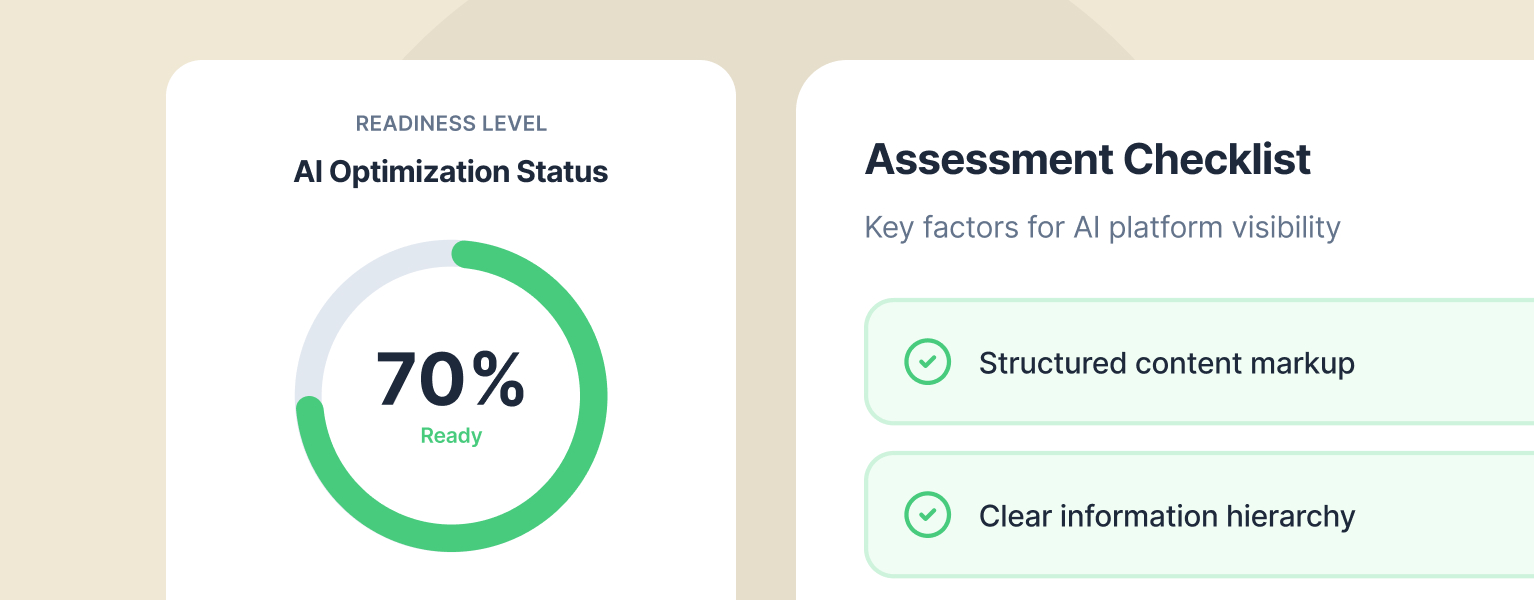
What Is An AI Readiness Assessment?
Before auditing your site for AI visibility, understand whether your organisation is ready to act on what you find.
A GEO strategy is not a one-time project. It is an ongoing programme across technical health, content architecture, entity building, and measurement — one that compounds over time as your brand signals become more established and your content more comprehensively covers your topic area.
Begin with the technical foundation. Fix any crawler access issues first — they are the highest-impact changes and typically the quickest to implement. Then audit your schema markup across key pages and close the gaps. Technical issues are the floor: without them resolved, every other investment in content or entity building operates at reduced efficiency.
Content work follows a clear priority sequence. Start with your commercially most important pages and restructure them for AI extractability — answers visible early, headings that mirror the questions people ask, content that demonstrates genuine depth and direct expertise rather than broad surface coverage. Then extend outward to your wider content library. The aim is not to rewrite everything at once, but to systematically improve the pages where citation would have the greatest business impact.
Entity building runs in parallel over a longer timeframe. It means publishing original research, contributing perspectives to sector publications, ensuring your brand is described consistently across every external platform, and building the kind of third-party recognition that AI platforms use as a proxy for authority. There are no shortcuts here — but the compound effect is real. Brands with established entity signals across their sector see more consistent AI citations across a wider range of queries, not just the ones their pages explicitly target.
Establish your measurement framework before you start, not after. Track citation frequency across platforms monthly. Monitor AI referral traffic in your analytics (look for referrals from chatgpt.com, perplexity.ai, and gemini.google.com). And revisit your LLM audit score monthly to see whether your changes are moving the needle. Without a baseline, you cannot distinguish progress from noise.
For those building out a full content cluster around GEO, this guide is the pillar that each supporting article links back to. Forthcoming articles in this cluster will cover AI content strategy, what WordPress sites specifically need to do to prepare for AI search, and how to approach AI visibility for e-commerce and hospitality — each expanding on a specific tactical area this guide frames.
GEO for WordPress Sites
WordPress is well-positioned for GEO — more so than many enterprise CMS alternatives. Its architecture is flexible, extensible, and supported by a plugin ecosystem that addresses most of the technical and content requirements GEO demands.
Crawl access is managed through your robots.txt file, which can be edited directly or controlled via plugin. Schema markup is handled comprehensively by Yoast SEO and Rank Math, with custom extensions available for specific content types. The REST API and WPGraphQL make WordPress content accessible to external services and tooling — including the AI platforms themselves. And because WordPress is open-source, the community responds quickly: new GEO-specific plugins and configurations emerge as requirements evolve.
We recently published a piece on how we connected WordPress directly to AI assistants using the Abilities API and MCP — giving AI tools the ability to manage content, audit SEO, and analyse visitor behaviour within the CMS itself. That infrastructure underpins how we monitor and improve AI visibility for our clients on an ongoing basis, rather than in one-off audit cycles.
For organisations on Sitecore, Optimizely, or other legacy DXP platforms who are evaluating migration options, this is worth factoring into the decision. WordPress’s composable architecture makes it significantly easier to implement the full GEO technical stack — schema management, crawl configuration, structured content, and AI integrations — than closed or proprietary systems where customisation is constrained by platform boundaries and licensing.
Measuring GEO Performance
GEO performance does not look like SEO performance. There is no single equivalent of a ranking position report — measurement happens across several connected dimensions, each giving you a different view of how your brand is performing in AI search.
Citation frequency is the primary signal. How often does your brand or content appear when users query AI platforms with the keywords and questions you are targeting? This can be tracked manually — query each platform with your key search terms and record whether you appear — or through tools that automate the process at scale. Our LLM AI Optimisation Audit handles this automatically, tracking citation rates across ChatGPT, Gemini, Perplexity, Claude, and Copilot simultaneously and returning platform-by-platform scores.
Mention accuracy matters alongside frequency. If you are cited, how are you described? Is the description accurate, current, and aligned with your positioning? AI platforms can generate summaries of your brand based on whatever content is most accessible in their training data — which may be outdated or unrepresentative of your current offer. Monitoring for accuracy is part of ongoing GEO management, not just an initial check.
AI referral traffic in your analytics gives you a direct measure of sessions generated by AI citations. Look for referrals from chatgpt.com, perplexity.ai, gemini.google.com, and copilot.microsoft.com. Set up channel groupings in GA4 to separate this traffic from other referral sources. As AI search grows, this segment is likely to become increasingly significant — and tracking it from the outset gives you a baseline against which to measure the impact of specific interventions.
Set a monthly review cadence and track these metrics together. GEO moves slowly enough that weekly reviews add noise rather than insight — but consistent monthly measurement will reveal meaningful trends within three to four months of a structured programme. Pair citation tracking with organic ranking data and AI referral traffic, and you will develop a clear picture of which changes are working and where further investment is justified.
How Filter Approaches GEO
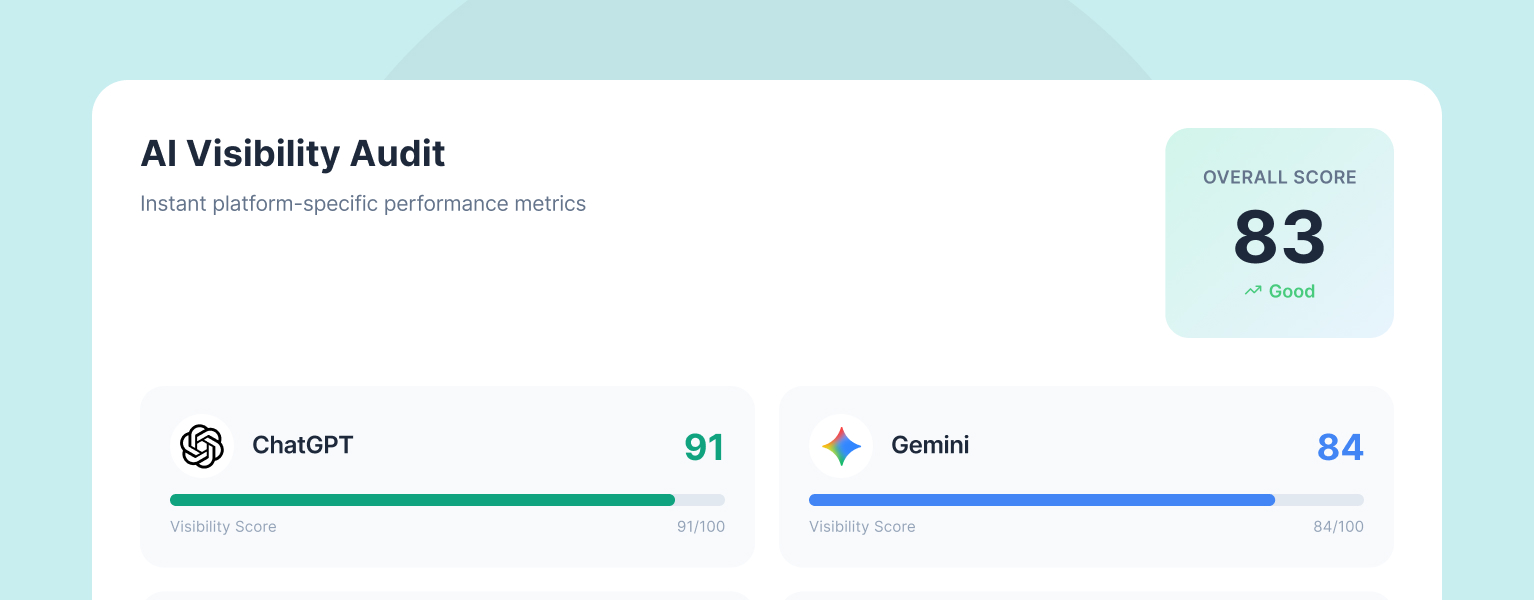
Our starting point for every engagement is the LLM AI Optimisation Audit. It runs automatically against your website, scanning over 90 ranking factors across ChatGPT, Gemini, Claude, Perplexity, AI Overviews, and Bing Copilot. You receive an overall visibility score, individual scores per platform, and a prioritised action plan that tells you exactly where to focus first. It is free, it takes seconds, and it gives you a concrete baseline before any strategy work begins.
For clients who want to go further, we build structured GEO programmes that combine technical implementation, content strategy, and ongoing measurement. That includes resolving crawler access issues, implementing schema across all content types, restructuring key pages for AI extractability, and building the earned media and entity signals that drive sustained citation authority over time.
We deploy Filter AI — our open-source WordPress plugin — to accelerate content enhancement at scale, including schema generation, SEO metadata, and alt-text automation across large content libraries. And we use PersonalizeWP to ensure that when AI-referred visitors arrive on site, they receive relevant, personalised experiences that are matched to their context and convert accordingly.
We are a WP Engine EMEA Agency Partner of the Year and WordPress VIP Silver Partner, with more than 20 years of experience building high-performance WordPress platforms for organisations including JD Wetherspoon and Medivet. We are not selling a GEO tool. We are helping clients understand a significant and lasting shift in how search works — and building the platforms and programmes that respond to it effectively.
If you want to understand where your site stands right now, run the free audit. If you want to talk through what a structured generative engine optimisation programme looks like for your business, get in touch.
Having worked in agencies since he left university, Paul drives both the technical output at Filter, as well as being responsible for planning. His key strengths are quickly understanding client briefs and being able to communicate complex solutions in a clear and simple manner.
Our guide shows digital leaders and development teams how structured data earns AI citations now that systems like ChatGPT and AI Overviews, not rich results, decide visibility.
Download our practical guide to AI and WordPress, covering the new Abilities API, MCP Adapter and AI Client in core, plus how to prepare your platform for the agentic web.
Sitecore to WordPress: What to Expect from the Migration
Your Sitecore contract renewal is approaching and the numbers no longer add up. Before you commit to a migration, here is what actually happens when enterprise teams move from Sitecore to WordPress — the real costs, the content challenges, the SEO risks, and the decisions that separate smooth transitions from expensive false starts.