AI Content Strategy: Writing for AI-Powered Search
23 April 2026 •
10 mins read
Most ai content strategy advice starts in the wrong place. It treats AI search as a writing challenge — cleaner sentences, better headlines, shorter paragraphs. That framing is not wrong, but it is incomplete. The majority of content that fails to appear in AI-generated answers does not fail because it is badly written. It fails because it was built for a different discovery system entirely.
Your content library is almost certainly larger than you need. For most mid-market and enterprise organisations, the challenge is not volume — it is reach. In 2026, AI-generated answers appear in more than a quarter of all Google searches, up from 13% in early 2025. Around 93% of AI-assisted search sessions end without a website visit. The audience is there. The question is whether your content is reaching them.
This is not primarily a traffic problem. It is an authority and architecture problem — and fixing it means understanding which signals AI platforms use to decide whose content gets cited, and then building a strategy that deliberately develops those signals. Writing more is rarely the answer. Writing differently, and structuring what you have more carefully, almost always is.
What Most Content Strategies Get Wrong
The most common misdirection in AI content strategy is treating citation visibility as a volume problem. Publish more articles. Cover more keywords. Increase cadence. Some organisations have spent the past 18 months doing exactly this and found that their appearance in AI-generated answers has barely moved. That is because volume and breadth are not the primary variables. Topical depth is.
The second misdirection is treating it as a formatting problem. Shorter paragraphs, more bullet points, cleaner headings. These changes matter at the margins, but they will not rescue content that lacks genuine authority or fails to answer the question being asked directly and early.
The more significant shift — one that has become clearer as AI platforms have matured — is toward experience. AI models can generate commodity information: general explanations, summaries of widely-known facts, aggregated advice from across the web. What they cannot generate is first-hand perspective — the results of your actual client work, data from your own research, observations grounded in repeated practical experience. That content is, by definition, yours. It is what AI platforms increasingly value, and it is the one element no competitor can simply copy.
What AI Search Actually Selects For
Understanding how AI platforms decide what to cite changes what good content strategy looks like in practice. There are four dimensions that matter most.
Directness Before Depth
AI platforms retrieve pages and make near-instant decisions about utility. Content that delivers a clear, direct answer to the target question within the first 250 to 300 words is significantly more likely to be extracted and cited. This does not mean articles should be shorter — it means the most important information must come first, not after a context-setting introduction.
This is a structural shift for teams accustomed to writing for engagement, where the instinct is to draw the reader in before delivering the substance. For AI search, the substance leads. The supporting context and depth follow. Think of it as an inverted pyramid for every article, not just news writing.
Topical Depth Over Topical Breadth
Domain-level authority has become a stronger signal in AI citation decisions than individual page authority. A site that publishes five deeply researched, genuinely expert pieces on a specific subject area consistently outperforms one with fifty shallow articles covering thirty different topics. The signal AI platforms are reading is: does this site own this subject area?
This is why a well-structured content cluster — with a pillar guide connected to supporting articles, each adding depth on specific subtopics — performs more reliably than standalone pieces targeting individual keywords. It is also why internal linking matters for AI visibility, not just for Google. Our Definitive Guide to Generative Engine Optimisation covers how these cluster structures work in practice.
Attributable, Experience-Led Claims
Research from Princeton, Georgia Tech, and the Allen Institute for AI found that content containing specific citations, statistics, and clearly attributable claims receives AI citation rates more than 40% higher than generic content covering the same topics. The mechanism is straightforward: AI platforms need to anchor specific information to a source. Content built on specific assertions — “in our work with X”, “the data shows”, “we found consistently” — gives AI models the hooks they need for accurate attribution.
Generic content, by contrast, is harder to attribute to any particular source. If what you have published could have been written by any agency, it will not differentiate your site from others that have published similar material — and AI platforms will have less reason to cite you specifically.
Consistent Entity Signals
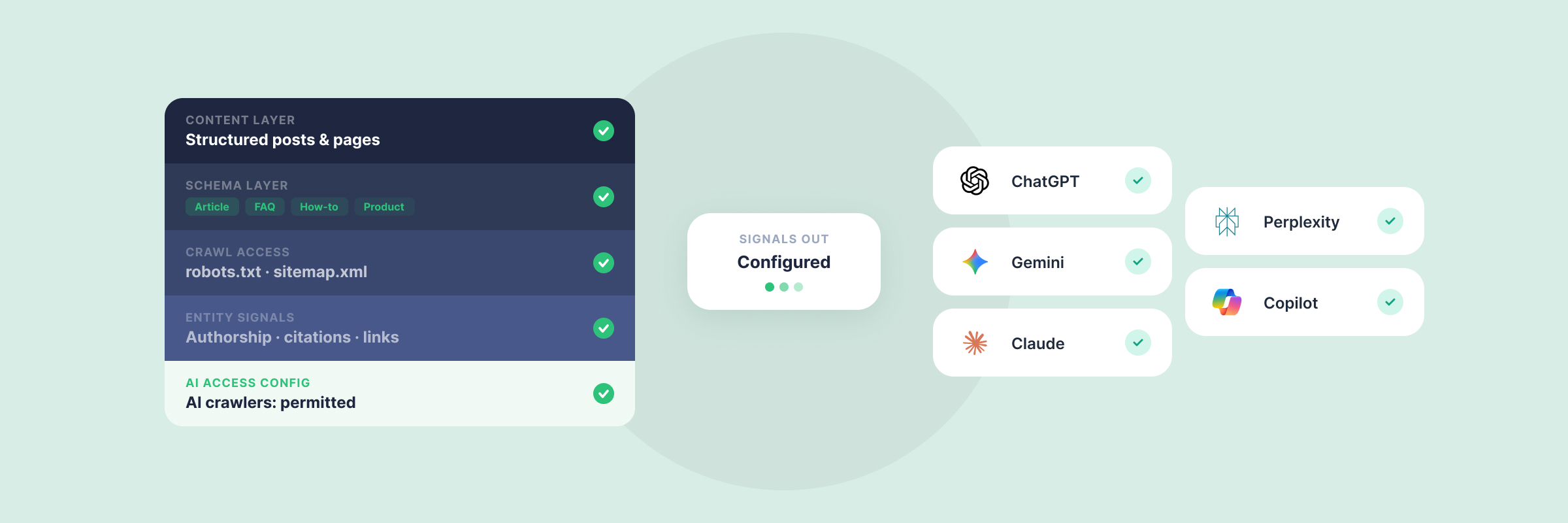
The authority AI platforms attribute to individual pieces of content is influenced by how consistently your brand is represented across the web. This includes your own site — homepage, about page, author bios — but also LinkedIn, Crunchbase, sector publications, and third-party directories. Inconsistency in how your organisation is described — different names, outdated credentials, mismatched descriptions — reduces an AI platform’s confidence in attributing content to your brand accurately. This signal area rarely appears on a content team’s radar, but it directly affects citation outcomes.
Free LLM AI Optimisation Audit
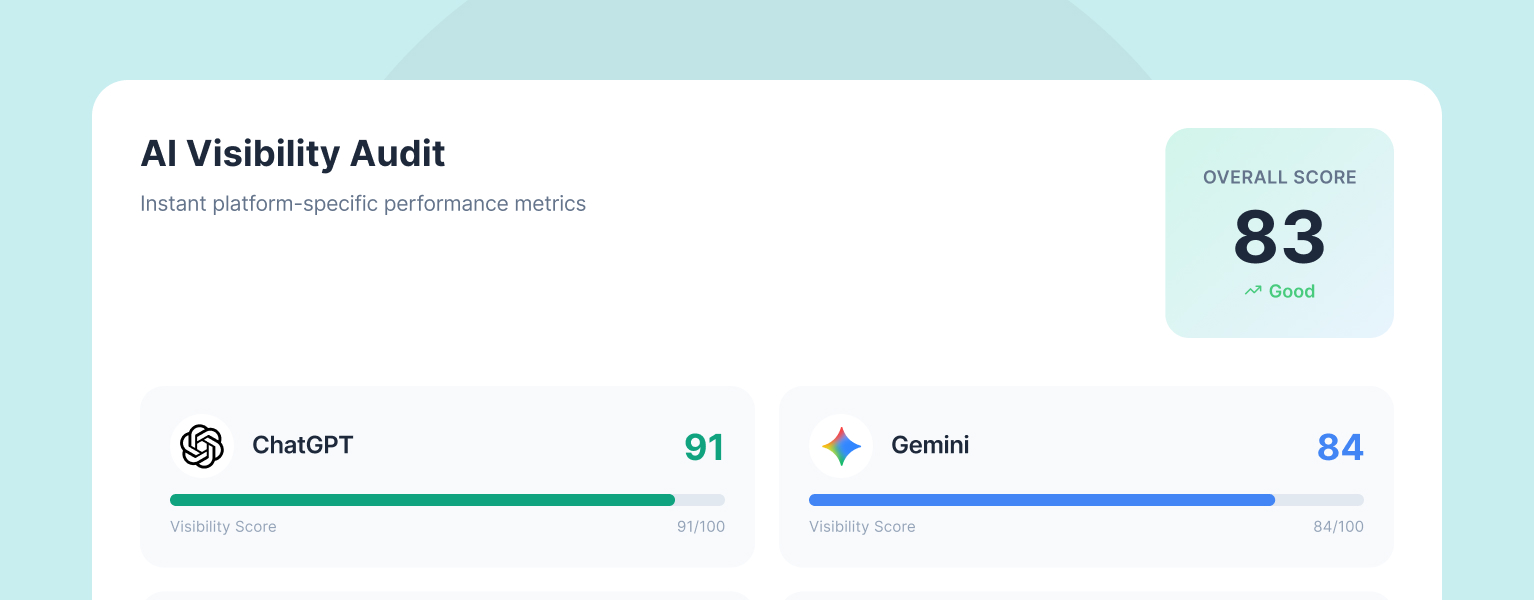
See how your website performs across ChatGPT, Gemini, Claude, Perplexity, and AI Overviews. Free, instant, and based on 90+ ranking factors.
The practical implication of the above is a change in how content gets briefed and structured — before a single word is written.
Start every piece by defining the specific question it exists to answer. Not the topic — the question. “AI content strategy” is a topic. “What should a content team change to get cited in AI-generated answers?” is a question. Briefing to a question forces the content to lead with its answer and reduces the risk of producing material that is informative but vague.
Within the brief, identify the proprietary element. What does your organisation know about this topic from direct experience rather than secondary research? For us, that means what we observe consistently when running LLM audits — patterns in what blocks citation visibility across different types of sites. That kind of specific, first-hand observation belongs in the content. It is attributable and cannot be replicated from public sources.
Structure headings to mirror the language of actual queries. “How do you brief content for AI search?” is a more useful heading than “Content Briefing Best Practices.” The closer your heading language is to how someone would phrase a question to an AI platform, the more likely your content is to be retrieved for that specific query. This applies to H2s and H3s throughout the piece, not just the title.
Finally, define any key terms you use. Content that establishes clear, consistent definitions for the concepts it covers is easier for AI platforms to extract and attribute accurately — and it signals topical authority in its own right. If you are publishing content on generative engine optimisation, define it precisely and consistently across everything you publish on that topic.
Auditing What You Already Have
For most organisations, the highest-value AI content work is not creating new content — it is improving what already exists. A well-structured content audit will surface pages that have reasonable authority signals but poor answer structure, pages with solid structure but outdated or thin content, and pages that could be consolidated into fewer, deeper pieces.
The key questions to apply to each page: does it answer its target question within the first 300 words? Does it include specific, attributable claims — data, client references, named tools or approaches? Is it the deepest treatment of its topic area on your site, or does it duplicate or overlap with similar content elsewhere?
Thin content that repeats what every other site has published is worth either deepening substantially or consolidating into a page that can carry more authority. Two medium-quality pieces on adjacent topics will almost always perform worse than one comprehensive piece that covers both. This consolidation work is undervalued in most content strategies and consistently produces measurable improvements in AI citation rates.
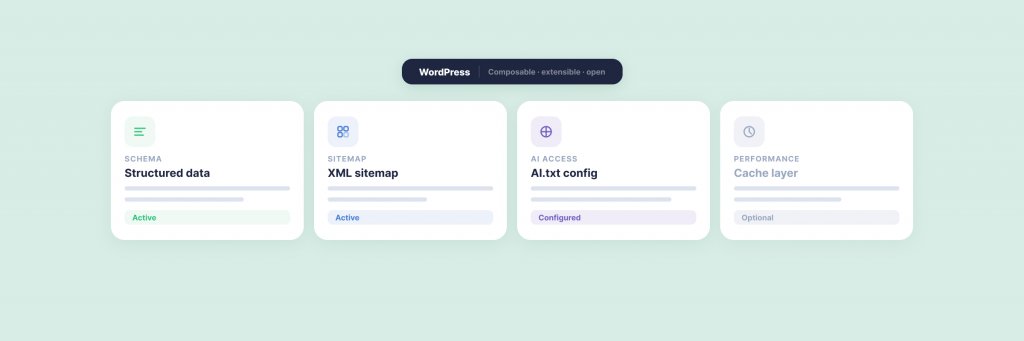
We use Filter AI — our open-source WordPress plugin — to run content audits at scale, surfacing SEO metadata gaps, missing schema, and pages that would benefit from structural improvements. For large content libraries, this kind of systematic review is far more efficient than manual assessment and surfaces the highest-opportunity pages first. Our existing guide on how to optimise your website content covers the broader fundamentals of content structure if you are revisiting the foundations alongside this work.
The Experience Advantage
There is a clear ceiling on what commodity content can achieve in AI search, and that ceiling is likely to fall as AI platforms get better at distinguishing source-specific authority from aggregated generic material. The content that will continue to perform well is the kind that reflects genuine depth of experience — real results from real client work, perspectives shaped by doing something repeatedly across different organisations and contexts, observations grounded in your own data rather than in a synthesis of what others have published.
This is the content that neither a competing agency nor a large language model can reproduce from scratch. For Filter, it means the case studies built with clients like JD Wetherspoon and Medivet, the patterns we see across hundreds of LLM audits, and the design decisions that went into building PersonalizeWP. Those are not marketing assets. They are the primary material of a content strategy that compounds over time.
If you are reviewing your content strategy with AI visibility in mind, the question to ask about each piece is not “is this well-written?” but “does this contain something only we could have written?” The answer to that question is a more reliable guide to AI citation potential than any other single factor.
The Definitive Guide to Generative Engine Optimisation
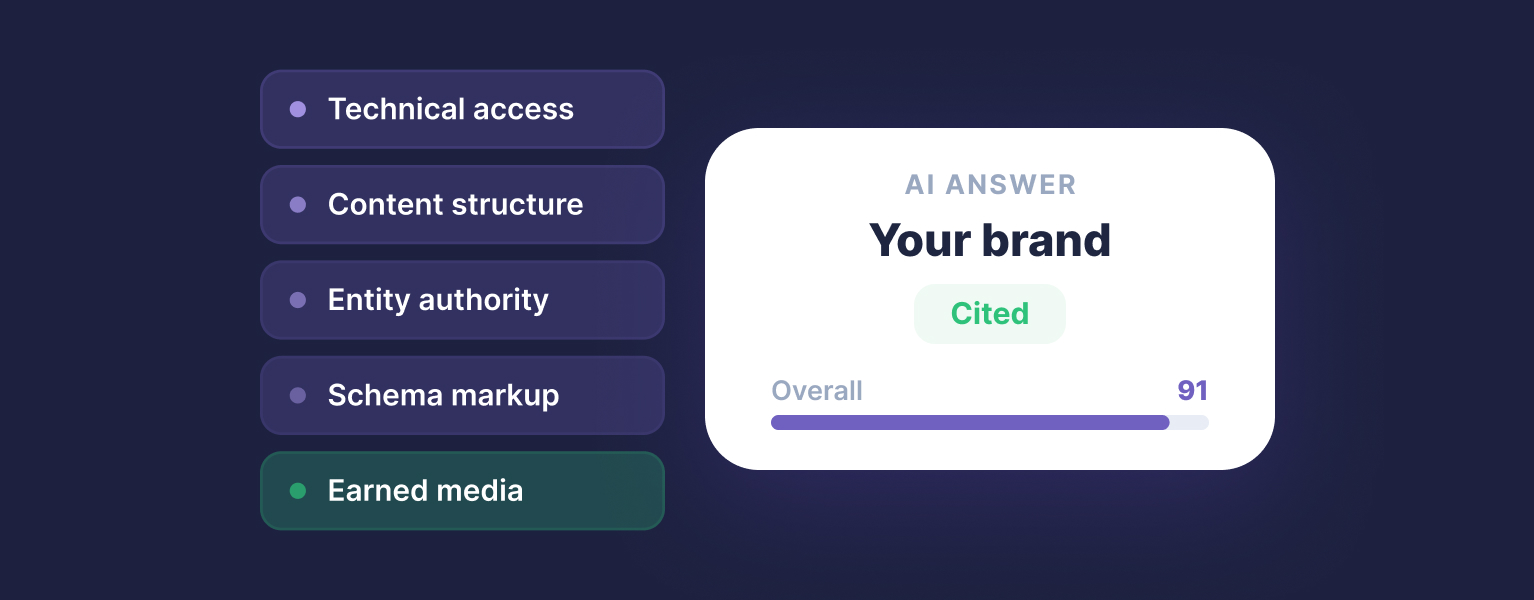
AI content strategy sits within a broader GEO framework. Our definitive guide covers the full picture — technical access, entity authority, schema, and how to measure what is working.
Measuring Whether Your Strategy Is Working
The metrics for AI content performance are different from traditional SEO metrics. Organic ranking positions and click-through rates do not directly tell you whether your content is being retrieved and cited by AI platforms.
The most direct measure is citation tracking: querying ChatGPT, Google Gemini, Perplexity, Claude, and Bing Copilot with the keywords and questions you are targeting, and recording whether your content appears. Do this monthly against a consistent set of queries and you will start to see whether your strategy is generating movement. Pair this with AI referral traffic in GA4 — referrals from chatgpt.com, perplexity.ai, and gemini.google.com — which gives you a direct session-level measure of what AI citations are delivering.
Our AI SEO audit guide covers both measurement areas in detail, including how to set up GA4 channel groupings for AI referral traffic and what a monthly review cadence should look like in practice. The key principle is to establish a baseline before you start making changes — so you can see clearly which interventions are working.
How Filter Approaches AI Content Strategy
Our starting point for any content strategy engagement is understanding where the current gaps sit. That begins with the LLM AI Optimisation Audit — a free, automated review that scans your site across more than 90 ranking factors, delivers individual scores for each major AI platform, and returns a prioritised action plan. It tells you where you are before you decide where to focus.
From there, we work with your team to restructure existing content for AI extractability, build out content clusters with proper internal linking, and develop a briefing approach that ensures new content is structured correctly from the outset. We deploy Filter AI to accelerate schema implementation, metadata generation, and bulk improvements across large content libraries.
Critically, we treat content strategy and technical GEO work as a single programme. A well-structured piece of content will not reach its potential if the site’s crawl configuration is preventing AI platforms from accessing it, or if entity signals across your brand presence are inconsistent. The content work and the technical work need to move together. Our LLM Audit surfaces both types of issue in one report, which is why it is the right place to start.
We are a WP Engine EMEA Agency Partner of the Year and WordPress VIP Silver Partner, with more than 20 years of experience building high-performance WordPress platforms for organisations including JD Wetherspoon and Medivet. We are not an AI content tool vendor. We are a WordPress agency that understands how content strategy, technical architecture, and search visibility intersect in practice — and how to build programmes that deliver measurable results.
If you want to understand your current AI visibility position, run the free audit. If you would like to talk through what a structured AI content strategy looks like for your organisation, get in touch.
Having worked in agencies since he left university, Paul drives both the technical output at Filter, as well as being responsible for planning. His key strengths are quickly understanding client briefs and being able to communicate complex solutions in a clear and simple manner.
Our guide shows digital leaders and development teams how structured data earns AI citations now that systems like ChatGPT and AI Overviews, not rich results, decide visibility.
Download our practical guide to AI and WordPress, covering the new Abilities API, MCP Adapter and AI Client in core, plus how to prepare your platform for the agentic web.
Sitecore to WordPress: What to Expect from the Migration
Your Sitecore contract renewal is approaching and the numbers no longer add up. Before you commit to a migration, here is what actually happens when enterprise teams move from Sitecore to WordPress — the real costs, the content challenges, the SEO risks, and the decisions that separate smooth transitions from expensive false starts.