How Personalisation Drives Revenue in Hospitality and Travel
30 April 2026 •
11 mins read
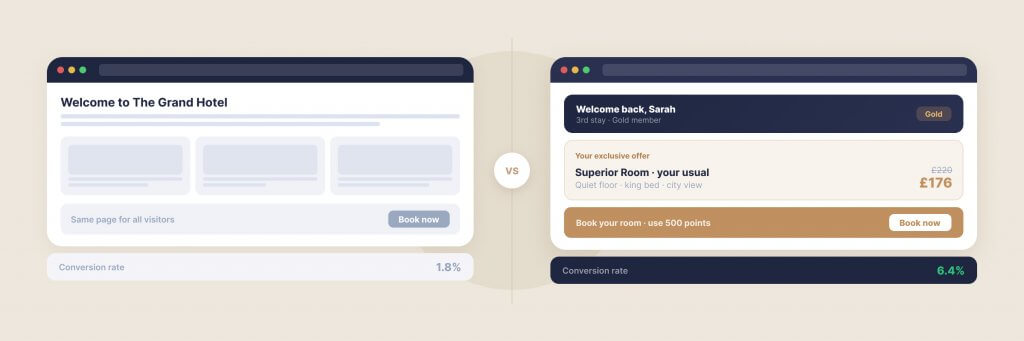
A hotel group runs the same website for every visitor — the same hero image, the same room grid, the same “Book Now” button. Two hundred people visit the site each day. Three of them book. That is a 1.5% conversion rate, which is average for the hospitality sector. Now imagine a version of that site where a returning visitor from Manchester sees a weekend break package with availability for their preferred dates. A German visitor sees pricing in euros with translated room descriptions. A corporate booker sees meeting room capacity and day delegate rates instead of spa treatments. The rooms are the same. The site is the same. The personalised web experience is what changes — and it is what moves the booking rate from 1.5% to something meaningfully higher.
The Revenue That Generic Websites Leave Behind
Most hospitality businesses understand that personalisation matters. Eighty-six per cent of UK travellers say they appreciate personalised offers. Guest satisfaction scores at hotels using personalisation are up to 33% higher than those that do not. Yet the majority of hotel and travel websites still show every visitor the same content, the same imagery, and the same calls to action regardless of who they are, where they come from, or what they have already told the business through their behaviour.
The gap is not awareness. It is execution. Many hospitality teams assume that delivering a personalised web experience requires a six-figure digital experience platform (DXP) or a dedicated data science function. Neither is true. The technology to personalise a WordPress-based hospitality site is available today at a fraction of the cost — and the returns are measurable within weeks, not quarters.
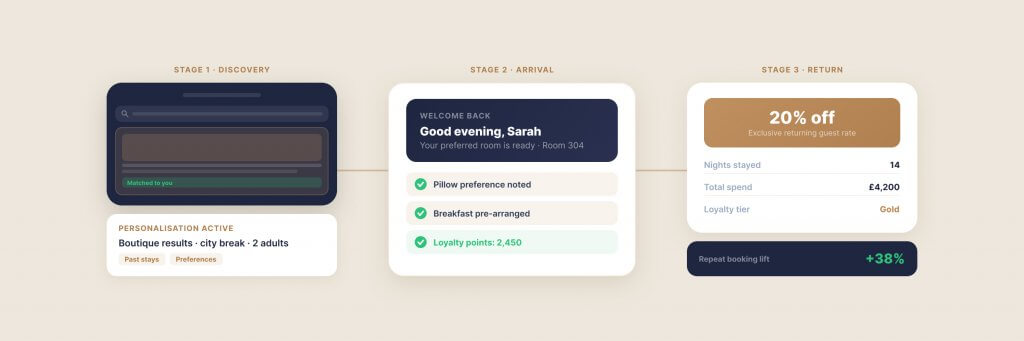
This article follows the guest journey from first visit to post-stay loyalty, showing where personalisation directly affects revenue at each stage. It is written for hospitality and travel marketers who want practical examples, not theory — and who want to know what they can start doing now.
Research and Discovery: Capturing Attention in the First 10 Seconds
A traveller looking for a weekend in the Lake District opens their browser. They might arrive from a Google search, an Instagram ad, a referral from a travel blog, or increasingly from an AI recommendation via ChatGPT or Perplexity. Each of those entry points tells you something different about what they want.
A paid search visitor clicking an ad for “dog-friendly hotels Lake District” has already told you their top priority. If your homepage shows a couple in a spa, you have lost the connection before they have scrolled. If it shows a dog bounding across a fell with your hotel in the background, followed by pet-friendly room options and your dog welcome policy, you have matched intent to content in the first screen. That match is what personalisation delivers.
What to Personalise at This Stage
Hero content by traffic source. Visitors arriving from paid campaigns targeting specific audiences (families, couples, corporate) see hero imagery and copy that reflects their segment. This is not complicated — it requires one rule per campaign and one content variation per audience. The impact on bounce rate is immediate.
Geographic relevance. A visitor browsing from Germany or France sees pricing in their currency and a translated summary of your key selling points. For UK hotel groups with international appeal, this removes a friction point that costs bookings every day. Currency display alone can lift conversion from international visitors by double digits.
Return visitor recognition. Someone visiting your site for the second or third time is not browsing casually — they are comparing. Show them what they looked at last time. Surface availability for the dates they previously searched. Acknowledge that they have been here before. A returning visitor who sees “Welcome back — the Garden Suite you viewed is still available for 14–16 June” is closer to booking than one who sees the generic homepage again.
Website Personalisation: The Complete Guide
New to personalisation? Our pillar guide covers segmentation strategy, what to personalise on your site, the technology required, and how to measure results.
The Booking Decision: Where Personalisation Converts to Revenue
The average hotel website conversion rate sits below 2%. For independent properties, it can drop to 0.5–1.5%. Every fraction of a percentage point improvement translates directly to revenue — on a site generating 6,000 visits per month, moving from 1.5% to 2.5% adds 60 additional bookings. At an average rate of £150 per night for a two-night stay, that is £18,000 in additional monthly revenue from the same traffic.
Personalisation during the booking stage is where these gains materialise.
Upsell at the Right Moment
A guest selecting a standard double room does not need to see your entire room portfolio. They need to see the one upgrade that makes sense for them — and the reason to take it. For a couple booking a Saturday night, that might be a room with a view and a late checkout. For a family, it might be an interconnecting room with a cot already included. For a corporate booker, it might be a room with a desk and complimentary wifi.
Serving the right upsell to the right segment at the point of selection is one of the highest-impact personalisation tactics in hospitality. It increases average order value by 10–20% without requiring additional traffic. The content exists — room descriptions, upgrade options, add-on packages — it just needs to be shown to the right person at the right time.
Social Proof That Matches the Visitor
A family researching a half-term break gains confidence from reviews written by other families. A business traveller trusts feedback from corporate guests. Showing segment-matched testimonials and reviews at the point of booking decision removes doubt in a way that generic five-star ratings cannot. This is personalisation at the engagement layer — and it is remarkably effective at reducing drop-off between room selection and confirmed booking.
Urgency That Feels Helpful, Not Manipulative
Showing a returning visitor that availability for their searched dates has decreased since their last visit is not pressure — it is useful information. “Two rooms left for your dates” shown to someone who viewed those dates three days ago is personalisation working in the visitor’s interest. It also drives conversion. Behavioural triggers like these, shown at critical points in the booking funnel, consistently produce measurable uplifts.
During the Stay: Digital Touchpoints That Drive Spend
Personalisation does not stop at the booking confirmation. The on-property digital experience — guest portals, pre-arrival emails, on-site web apps — represents a revenue opportunity that most hospitality brands underuse.
A pre-arrival email that offers a couple a spa package and a family a kids’ activity programme is straightforward segmentation. But the revenue potential deepens when you connect website behaviour to on-property offers. A guest who browsed your restaurant page three times before booking is signalling interest — a pre-arrival message offering a table reservation with a complimentary aperitif converts that interest into spend.
For hotel groups and multi-property operators, personalising the on-site experience by property type, guest history, and booking channel creates consistency across the portfolio while letting each property feel distinct. A guest who stayed at your Edinburgh property and is now visiting your Bath location should not feel like a stranger. Their preferences, their loyalty status, and their history should carry across — and the digital touchpoints should reflect that.
After Check-Out: Turning One Stay into Three
The most expensive booking is the first one. Acquiring a new guest through paid search or OTA commission costs significantly more than bringing a previous guest back through your own channels. Personalisation after the stay is where that equation shifts.
Post-Stay Emails That Earn the Next Booking
A follow-up email that says “Thank you for your stay” is polite. One that says “Thank you for your stay — here is a winter rate for the suite you loved, available for the weekend of 22 November” is personalised, timely, and actionable. The difference in rebooking rates between generic and personalised post-stay communications is substantial. Hotels that personalise post-stay emails based on room type, stated preferences, and on-property behaviour see retention rates up to 20% higher than those sending uniform communications.
Website Personalisation for Returning Guests
When a previous guest returns to your website — whether from a post-stay email, a retargeting ad, or a direct search — they should not see the same experience as a first-time visitor. They already know your property. They have already stayed. What they need is a reason to come back: a new package, a seasonal offer, an upgrade on their previous room type, or availability for the dates that match their last visit pattern.
This is where lead scoring becomes valuable. A guest who has stayed twice, opened your last three emails, and visited your website this week has a high intent score. Showing them a direct booking incentive — a room upgrade, a complimentary treatment, a best-rate guarantee — is more likely to convert than a generic promotion, and it costs a fraction of acquiring a new guest through an OTA.
PersonalizeWP — Free WordPress Personalisation
Show the right content to the right visitor in the right language. PersonalizeWP works alongside WPML and other multilingual plugins to deliver region-specific, personalised experiences — completely free.
Every hospitality business wants more direct bookings. OTA commissions — typically 15–25% — are the single largest distribution cost for most hotels. Yet many properties treat their own website as a static brochure while paying commissions on bookings that could have been captured directly.
Personalisation is the mechanism that makes your website competitive with OTAs. Booking.com and Expedia already personalise aggressively — they show different results, prices, and urgency messages to different visitors based on search history, location, and behaviour. Your website needs to do the same, or it will always feel like a step down from the OTA experience.
The tactics are specific and implementable. Show a best-rate guarantee banner to visitors who arrived from an OTA comparison. Display a loyalty incentive to returning guests who previously booked through a third party. Surface a direct booking benefit — free breakfast, late checkout, a room upgrade — to visitors whose behaviour indicates they are comparing prices. Each of these rules targets a defined segment with a defined offer, and each one shifts bookings from commission-heavy channels to your own.
For a 100-room hotel running 70% occupancy, shifting just 10% of OTA bookings to direct saves tens of thousands of pounds annually in commission. The personalisation rules that make this happen are not complex — they require the right tool, the right segments, and the right content variations. Not a platform migration or a six-month technology project.
What You Actually Need to Start
Hospitality teams often delay personalisation because they believe it requires a complete technology overhaul. It does not. If your website runs on WordPress — as many hotel and travel operator sites do — you can begin personalising content this week.
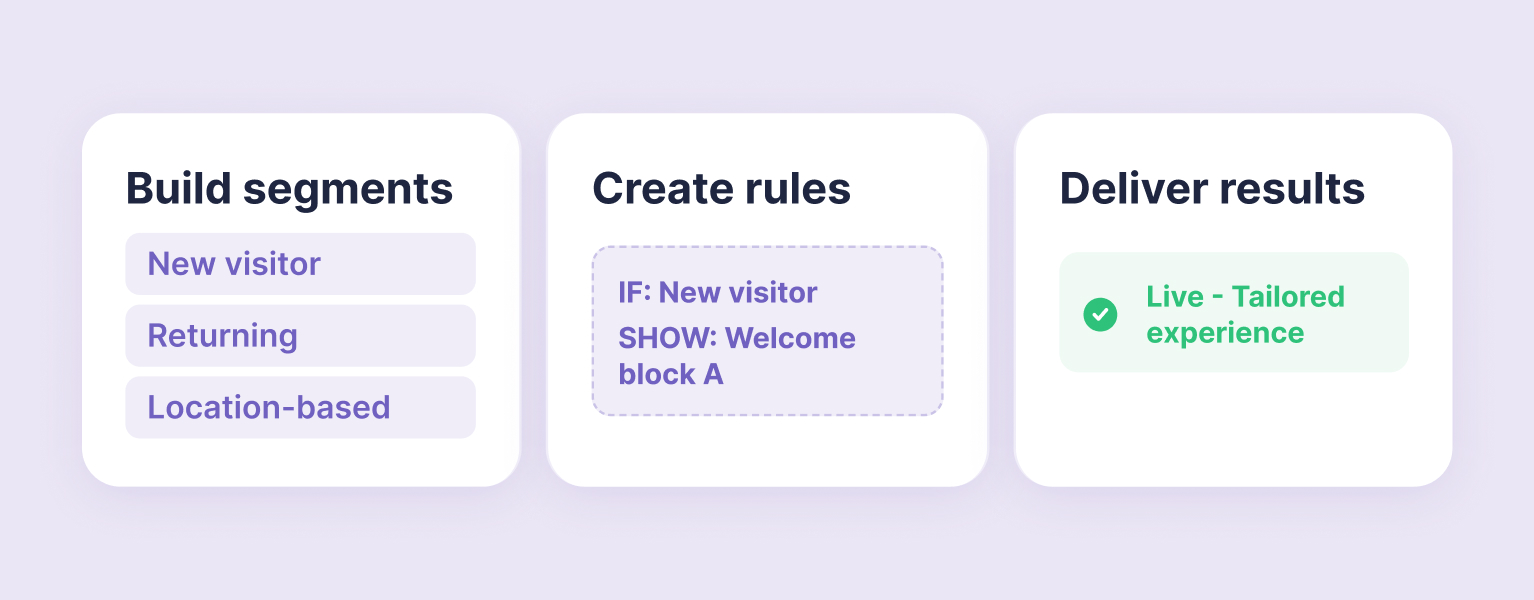
PersonalizeWP is a WordPress personalisation plugin we built specifically because we saw hospitality and mid-market clients priced out of DXP-level personalisation while still needing the capability. The free version covers the fundamentals: show/hide rules on any block, targeting by device, referral source, visitor type, time, date, and URL parameters. That is enough to implement the traffic-source personalisation and return-visitor recognition described above.
The Pro version adds visitor profiles, lead scoring, and compound segmentation — the features that power post-stay personalisation and behavioural targeting across sessions. A returning guest who viewed your spa page, stayed in a deluxe room, and has visited three times in the past year is a defined, scorable segment. PersonalizeWP lets you create that segment and show them content built specifically to convert their next booking.
Critically, PersonalizeWP works with cached sites and CDN services including Cloudflare. For hospitality sites running on WP Engine or WordPress VIP — where aggressive caching is standard — this is not a footnote. It is the difference between personalisation that works in production and personalisation that breaks your performance layer.
For teams wanting to measure what personalisation adds, Google Analytics 4 provides the segment-level reporting you need. Create audiences that mirror your personalisation rules — return visitors, traffic from specific campaigns, visitors from defined geographies — and compare conversion rates between personalised and non-personalised cohorts. Hotjar adds a qualitative layer: session recordings and heatmaps show you whether personalised content is being seen and engaged with, or whether placement and timing need adjusting.
How We Work with Hospitality Brands
We have worked with hospitality and travel businesses for over two decades, building and maintaining WordPress platforms that do more than look good — they perform. JD Wetherspoon, one of the UK’s largest hospitality operators, runs its digital platform on WordPress infrastructure we built and continue to support. Medivet, another long-standing client, uses PersonalizeWP to deliver personalised content to visitors across hundreds of practice locations.
Our AI and personalisation services team works with hospitality clients across three areas. First, segmentation strategy — defining the visitor groups that matter for your property and mapping the content variations that will move each one towards a booking. Second, implementation — building the personalisation rules in PersonalizeWP or through bespoke development where the requirement exceeds what a plugin covers. Third, measurement — connecting personalisation activity to revenue outcomes through analytics configuration and ongoing performance review.
We also work with hospitality brands on AI visibility — ensuring your property appears in AI search recommendations when travellers ask ChatGPT, Gemini, or Perplexity where to stay. Personalisation and AI visibility are complementary: the first converts traffic you already have; the second brings new traffic from discovery channels your competitors may not be visible on yet. Together, they form a complete digital growth strategy for hospitality businesses.
Ready to explore what a personalised web experience could deliver for your hospitality business? Try PersonalizeWP free or talk to our team about a personalisation strategy built around your properties, your guests, and your revenue goals.
Having worked in agencies since he left university, Paul drives both the technical output at Filter, as well as being responsible for planning. His key strengths are quickly understanding client briefs and being able to communicate complex solutions in a clear and simple manner.
Our guide shows digital leaders and development teams how structured data earns AI citations now that systems like ChatGPT and AI Overviews, not rich results, decide visibility.
Download our practical guide to AI and WordPress, covering the new Abilities API, MCP Adapter and AI Client in core, plus how to prepare your platform for the agentic web.
Sitecore to WordPress: What to Expect from the Migration
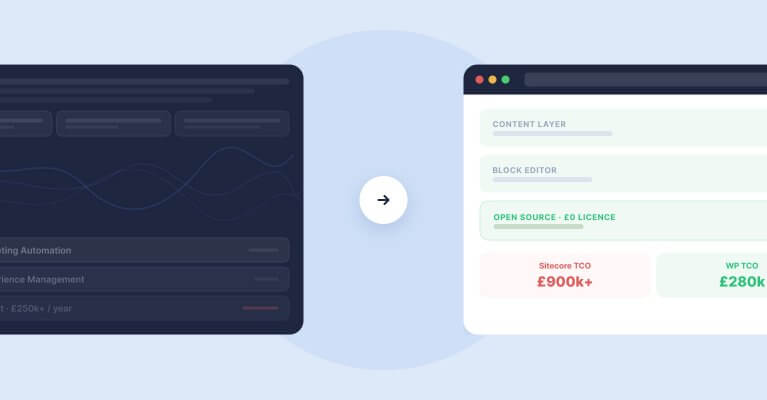
Your Sitecore contract renewal is approaching and the numbers no longer add up. Before you commit to a migration, here is what actually happens when enterprise teams move from Sitecore to WordPress — the real costs, the content challenges, the SEO risks, and the decisions that separate smooth transitions from expensive false starts.