AI for E-commerce: How AI Is Changing Online Retail
1 May 2026 •
8 mins read
Sixty-four per cent of UK consumers trust AI for e-commerce — the highest figure in Europe. That number, from a 2026 retail survey, tells you something important: this isn’t a technology story. It’s a customer behaviour story. From how shoppers discover products to how brands personalise experiences, manage stock, and price dynamically, online retail has changed substantially in the past 18 months. This piece sets out what’s actually happening, where the real commercial impact lies, and what it means for brands competing for attention and conversion today.
The Numbers Behind the Shift
The AI e-commerce market was valued at $8.65 billion globally in 2025 and is projected to reach $22.6 billion by 2032. That’s a useful context figure, but the numbers closer to home are more telling for UK retailers.
Eighty per cent of UK retailers expect online sales growth in 2026, and a majority are attributing that expectation specifically to AI improvements in personalised experience, customer service, and operational efficiency. Meanwhile, 30% of UK adults say they’re open to AI acting as a personal shopping agent on their behalf — browsing, comparing, and completing purchases without them being in the loop. That figure will only grow.
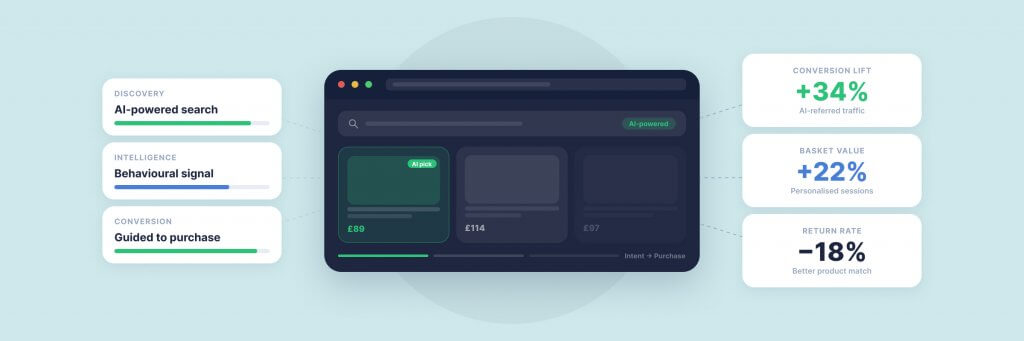
Adobe’s analysis of the 2025 holiday season is perhaps the most concrete signal yet. AI-driven traffic to retail sites grew 693% year-on-year. Revenue per visit from AI-referred shoppers was 84% higher than from non-AI sources. Conversion rates for AI-referred traffic were 31% above the average for traditional channels. These aren’t projections — they’re last year’s numbers, and they reflect a channel shift that’s already underway.
For UK brands, the question isn’t whether AI affects their e-commerce. It’s whether they’re positioned to benefit from it or lose ground to competitors who are.
Discovery Has Changed More Than You Think
The most immediate and commercially significant change in online retail is at the very top of the funnel: how customers find products.
Traditional e-commerce visibility was built around a predictable model. A customer types a keyword into Google, scans the results, clicks through to a product page, and — if everything holds — buys. Brands invested in ranking for high-intent terms, optimised product titles and descriptions for Google’s crawler, and tracked every step through the funnel. The model was legible, attributable, and optimisable.
That model still exists. But a growing share of shopping journeys now begin with an AI platform — ChatGPT, Perplexity, Gemini — rather than a search engine. When a customer asks an AI assistant which running shoes are best for flat feet and under £100, the system doesn’t return a ranked list of links. It evaluates the available information and recommends specific products or brands. If yours isn’t accessible to the AI — because your product data isn’t structured, your crawl access is blocked, or your content is thin — you’re not considered. The transaction happens without you.
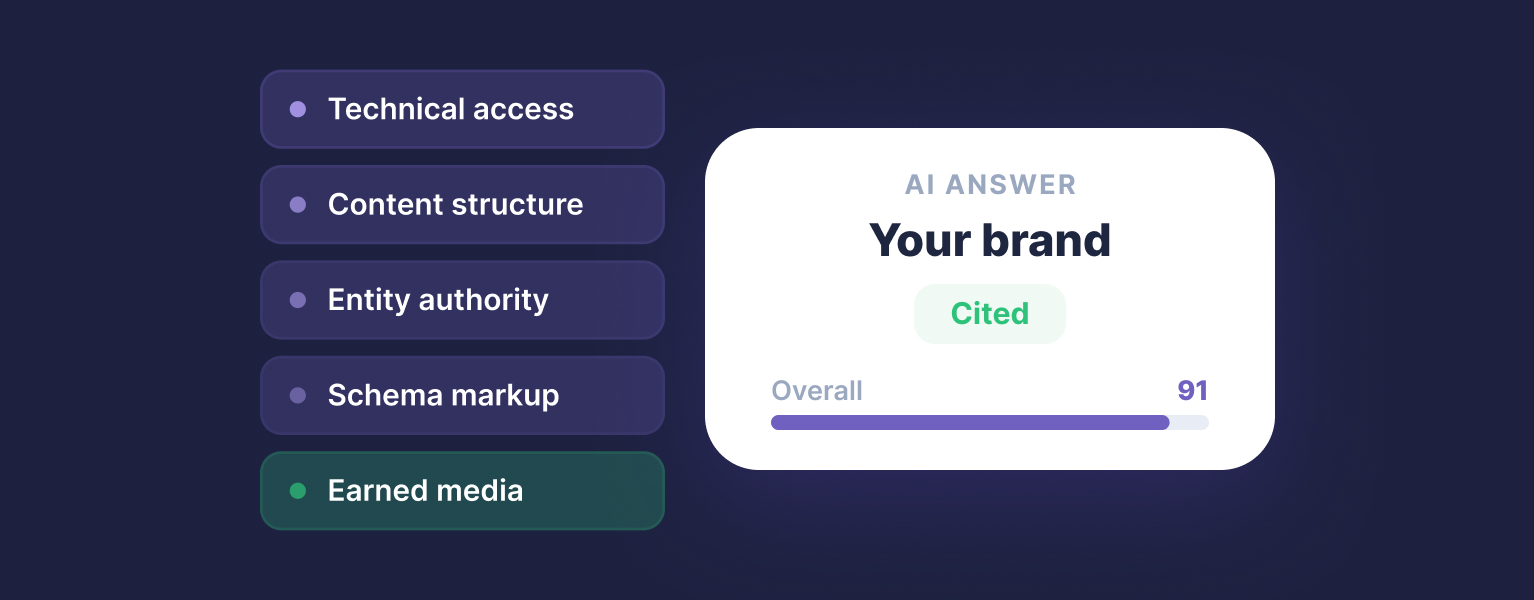
This is the shift that separates AI visibility from traditional SEO. Your search rankings don’t automatically translate to AI citations. The signals that matter are different: structured data quality, entity authority, content clarity, how well your brand is represented across trusted external sources. An e-commerce site ranking in Google’s top five might still be invisible to the AI platform that a significant portion of its prospective customers are now using to shop.
Our piece on agentic commerce goes into detail on what happens when AI agents act entirely on a customer’s behalf — completing purchases rather than just informing them. That’s the direction this is heading. The immediate commercial exposure is in AI-mediated discovery: being findable, citable, and trusted by the platforms now sitting between the shopper and your brand. Our Definitive Guide to Generative Engine Optimisation covers the technical foundations of what AI visibility requires.
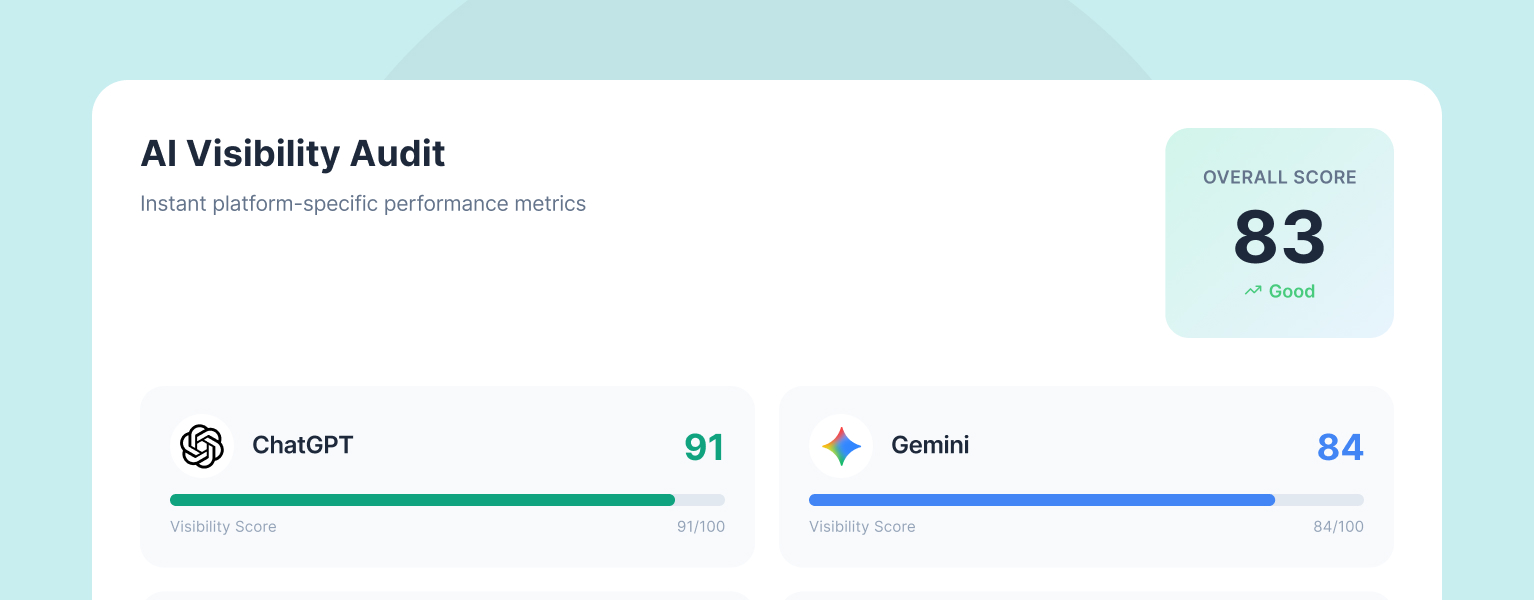
Free LLM AI Optimisation Audit
See how your website performs across ChatGPT, Gemini, Claude, Perplexity, and AI Overviews. Free, instant, and based on 90+ ranking factors.
Personalisation in e-commerce has been discussed for at least a decade. Most of what was called personalisation for the first eight of those years was, in practice, segmentation: group customers by broad behaviour, show different homepage banners to different cohorts, adjust email send times by geography. Useful, but not personal.
What’s changed is that AI makes real-time, individual-level personalisation operationally achievable at scale — not just for Amazon and ASOS, but for mid-market brands with well-structured data. Product recommendations account for up to 31% of e-commerce revenue on sites using AI-driven systems. Stores implementing them see an average 35% increase in average order value. Personalised emails deliver six times higher transaction rates than broadcast sends. A 2025 Forrester study found customers using Optimizely’s personalisation tools achieved a 446% three-year ROI, with payback in under six months.
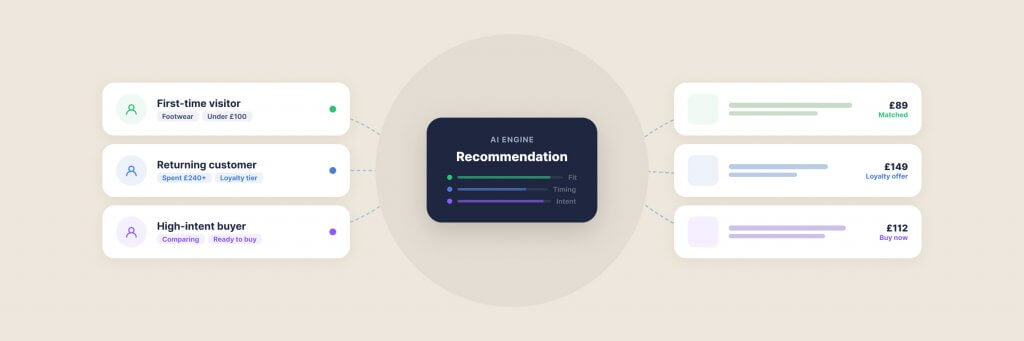
The mechanism is different from rules-based personalisation. Rather than manually defined segments, AI systems analyse individual browsing behaviour, purchase history, session context, and real-time signals to surface the right product or content to the right person at the right moment. The system learns continuously. The more data it processes, the better the recommendations become.
For brands on WordPress, this is increasingly accessible rather than aspirational. Tools like PersonalizeWP — our award-winning personalisation plugin — allow teams to deliver tailored content experiences based on user behaviour, location, referral source, and custom data attributes, without a bespoke development project for every new variation. The gap between what enterprise retailers can achieve and what a well-configured mid-market WooCommerce store can do has narrowed considerably.
The Operational Shift
The customer-facing changes attract most of the attention. The operational impact is at least as significant — and for many retailers, more immediately valuable.
Demand forecasting is the most established application. Retailers replacing spreadsheet-based planning with AI models are seeing meaningful reductions in overstock and stockouts — both of which carry a direct cost. AI analyses historical sales, seasonality, external signals (weather, upcoming events, social trends), and competitor pricing to generate rolling forecasts at SKU level. For businesses managing thousands of product lines, the difference in accuracy is material.
Dynamic pricing is the second shift. Where adjustments previously happened weekly or in response to known events, AI pricing tools now monitor competitor prices, demand signals, stock levels, and margin thresholds in real time, adjusting accordingly. This is standard practice in travel and hospitality. It’s becoming standard in retail more broadly — and the brands that aren’t doing it are, in effect, competing with one hand tied.
Customer service rounds out the operational picture. AI-handled enquiries — returns, tracking, product questions — can now resolve the majority of standard queries without human involvement, at any hour. For retailers managing seasonal traffic spikes, this isn’t primarily a cost play; it’s a service quality improvement that would otherwise require unsustainable staffing increases at peak.
The Challenge Nobody Wants to Discuss
More than a third of European retailers (36%) name keeping pace with AI as a major challenge. That’s an honest number, and it reflects something most AI-in-retail coverage tends to gloss over.
The biggest barrier isn’t budget — it’s data quality. AI personalisation systems, AI forecasting, and AI-mediated discovery all depend on clean, structured, accessible data. For many retailers, years of accumulated product data in inconsistent formats, customer records across disconnected platforms, and analytics setups never designed for AI consumption represent a genuine obstacle. The tools exist. The data readiness often doesn’t.
Platform constraints compound this. Retailers on tightly coupled, proprietary CMS or e-commerce platforms often can’t expose their product data to AI tools without significant integration work. Open architecture matters here — it’s one of the reasons WooCommerce on WordPress has become more compelling as an enterprise e-commerce foundation: you can integrate what you need, when you need it, without vendor approval or platform roadmap dependency.
Skills gaps are the third honest challenge. Most in-house teams aren’t equipped to evaluate AI tools critically, implement them correctly, or measure their actual impact. The vendor landscape is noisy, and claims are often difficult to verify without careful baseline measurement. Getting real value from AI in e-commerce requires someone who can separate genuine capability from marketing — and that’s harder than it sounds.
Where to Focus
Given the landscape, where does it make sense to start — or deepen — AI investment as an online retailer?
AI visibility is the most immediate commercial priority for any retailer relying on organic traffic. If your product pages aren’t findable by AI systems — because of crawler access issues, missing schema, or thin product data — you’re losing consideration before the customer reaches you. This is fixable, often without significant development work, and the impact is measurable relatively quickly. Our free LLM AI Optimisation Audit runs your site against the platforms that matter and tells you exactly where the gaps are.
On-site personalisation should follow. If you’re on WooCommerce, the tools to deliver meaningfully personalised experiences — different product recommendations, targeted offers, content adjusted by referral source — are available without enterprise-level investment. Getting this right consistently rewards the traffic you already have, regardless of how it arrives.
Operational AI is worth evaluating, but data readiness comes first. Investing in a forecasting or dynamic pricing tool before your product data and analytics are clean is unlikely to deliver the ROI vendors promise. The groundwork matters more than the tool.
For brands on WooCommerce specifically, we’ve written in depth about why WooCommerce positions merchants well for the shift to AI-powered shopping — covering how its open architecture and API surface make AI integration more achievable than on closed platforms. It’s a useful companion piece if you’re evaluating your platform choice alongside your AI strategy.
The Definitive Guide to Generative Engine Optimisation
AI shopping assistant visibility builds on the same foundations as broader AI search visibility. Our GEO guide covers the full picture — from technical access and structured data to entity authority and how to measure your results.
How Filter Works with Online Retailers
Our work with e-commerce clients spans platform development, personalisation implementation, and AI visibility. We build on WooCommerce and WordPress because the open architecture gives retailers the flexibility to integrate the tools and approaches that matter as this landscape evolves — without being locked into a vendor’s AI roadmap.
Filter AI — our open-source WordPress plugin — handles the content quality and schema work that underpins AI discoverability: generating structured metadata, alt text, and FAQ schema across large product catalogues in a fraction of the time manual approaches would require. For retailers with thousands of product pages, it’s often the fastest route to meaningful AI visibility improvement without a significant development engagement.
We’re a WP Engine EMEA Agency Partner of the Year and WordPress VIP Silver Partner, with over 20 years of experience building high-performance WordPress platforms for brands including JD Wetherspoon and Medivet. If you want to understand where your site stands today — what AI platforms can see, what they can’t, and what to fix first — run our free LLM AI Optimisation Audit. If you want to talk through what AI readiness looks like for your specific platform, get in touch.
Having worked in agencies since he left university, Paul drives both the technical output at Filter, as well as being responsible for planning. His key strengths are quickly understanding client briefs and being able to communicate complex solutions in a clear and simple manner.
Our guide shows digital leaders and development teams how structured data earns AI citations now that systems like ChatGPT and AI Overviews, not rich results, decide visibility.
Download our practical guide to AI and WordPress, covering the new Abilities API, MCP Adapter and AI Client in core, plus how to prepare your platform for the agentic web.
Sitecore to WordPress: What to Expect from the Migration
Your Sitecore contract renewal is approaching and the numbers no longer add up. Before you commit to a migration, here is what actually happens when enterprise teams move from Sitecore to WordPress — the real costs, the content challenges, the SEO risks, and the decisions that separate smooth transitions from expensive false starts.