About WordPress
WordPress is one of the most popular platforms around today, powering over 40% of all websites on the internet. It’s known for its simplicity, ease-of-use, and ever-evolving set of features, but many larger businesses still believe it’s not suitable for building a secure, reliable enterprise-grade website. That’s because WordPress has often been associated with smaller organisations and simpler websites, but those days are well and truly in the past.
WordPress is an open-source platform built on the PHP programming language. It is run and maintained by a large developer community, and anyone can access its source code to suggest updates, fix bugs, or build additional features. For business users, this is a significant benefit because it gives you full control over what you do with your website, and you won’t be locked in to any commitment with a solution provider.
About Optimizely
Optimizely (formerly Episerver) is a digital experience platform (DXP) that provides teams with tools and insights to create and optimise content. It rebranded from Episerver in 2021 following its merger with Optimizely, and has since repositioned as an enterprise-focused DXP with content management, commerce, experimentation, and AI-driven personalisation capabilities.
Optimizely operates as a proprietary, cloud-based platform. To build a website using Optimizely, you’ll typically be required to purchase licences as part of a subscription. Once you’re locked in, you have limited influence over the platform’s direction, so changes the vendor makes will impact your website — and possibly your wider business — whether you like it or not.
Key comparisons
Cost and affordability
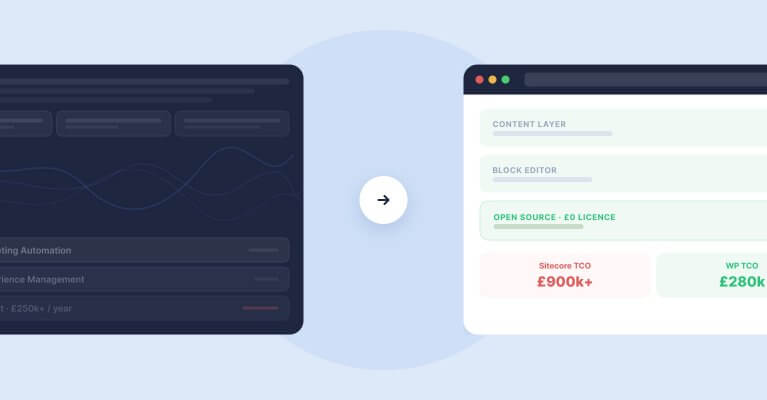
WordPress is open-source, which means it’s entirely free to use. No matter how complex or innovative your website, you won’t have to pay any licence fees — a valuable point of differentiation that can save you tens or hundreds of thousands of pounds per year compared to proprietary alternatives.
While you will likely need some budget for plugins, custom development, or integrations, these costs are minimal compared to purchasing a proprietary platform.
Optimizely comes with significant costs attached. Licences are known to be expensive, and the platform typically requires dedicated developer resources or certified implementation partners, adding further to the total cost of ownership. It’s also worth noting that almost everything you can achieve with Optimizely is achievable with WordPress, making the cost differential difficult to justify for most businesses.
User experience
WordPress is renowned for having a best-in-class user experience, great functionality, and highly intuitive content editing tools. The majority of first-time users can get comfortable with the platform almost immediately, even with no prior CMS experience — driving higher levels of productivity and efficiency across your team.
Optimizely can be more challenging from a usability perspective. Staff will often need specific training before using the platform, adding to the total cost of ownership and taking time away from day-to-day roles. That said, Optimizely does offer advantages in some areas — particularly around built-in experimentation and A/B testing capabilities, which are more mature out of the box than WordPress equivalents.
Security
Some assume open-source platforms carry greater security risk, but WordPress is perfectly safe for enterprise-level websites. The community actively releases bug fixes and security patches alongside regular core updates, and there are options to further strengthen your security posture — such as leveraging the WordPress VIP service to manage core updates and releases automatically from the cloud.
Optimizely, as a managed SaaS platform, handles a significant portion of infrastructure security on your behalf. However, all software can be vulnerable, and no platform eliminates the need for a trusted partner to support ongoing security reviews, integration management, and incident response.
Final thoughts
If you’ve been under the impression that there is no cost-effective solution available to build a high-functioning, secure website for your business, you’re not alone. Fortunately, we know from experience that WordPress is the ideal answer to that problem.
We’ve helped many organisations successfully achieve unique and complex requirements using WordPress, while saving significantly on cost and enjoying a better overall experience. Granted, there are cases where more specialist solutions will be necessary, but the vast majority of mid-market and enterprise clients will be best served by WordPress as the most cost-effective and pragmatic option available.
If you have any questions about a project of your own, or anything mentioned here, don’t hesitate to get in touch and we’d be happy to chat through them with you.