
WordPress and Sitecore are both platforms that can comfortably serve mid-market and enterprise-level businesses. But the differences between the two deserve careful consideration alongside your own website’s unique requirements. Here, we’ll compare the two, weigh up the pros and cons, and help you make the best decision for your business.
WordPress is an incredibly popular platform, renowned for its simplicity, ease-of-use, and ever-evolving set of features. Despite that popularity, many larger businesses still hold the misconception that it’s not sufficient for building a secure, reliable enterprise-grade website.
That’s because WordPress was historically associated with smaller organisations and simpler websites, but those days are gone. WordPress now powers over 40% of the internet, demonstrating just how many businesses trust its quality and reliability at scale.
Sitecore is a proprietary digital experience platform (DXP) built on the .NET framework. Originally an on-premise enterprise CMS, Sitecore has undergone a significant transformation in recent years, moving to a composable, cloud-native architecture under the Sitecore XM Cloud banner.
Building a website with Sitecore involves purchasing licences for the platform as part of a long-term subscription. Once you’re locked in, you have limited influence over the platform’s direction, and changes the vendor makes will affect your website whether you like it or not.
Because WordPress is open-source, it carries no licence fees. You can build a high-performing, enterprise-grade website while saving significantly over proprietary alternatives. You will likely need some budget for plugins and custom development, but these costs are minimal compared to purchasing a commercial platform.
Sitecore XM Cloud is expensive. Licences typically run to tens of thousands of pounds per year, and implementation requires specialist .NET developers and certified Sitecore partners, which adds further to the total cost of ownership. .NET developers also command higher day rates than PHP developers, widening the cost gap further. There is very little you can achieve with Sitecore that you cannot achieve with WordPress at a fraction of the cost.
WordPress could be chosen for its usability alone. Its content editing experience is highly intuitive — most users familiarise themselves with the platform almost immediately, even with no prior CMS experience. This drives higher levels of productivity and efficiency across your team from day one.
Sitecore is considerably more challenging from a usability perspective. Before using the platform, staff will typically need specific training to get to grips with the interface, adding to the total cost of ownership and taking time away from their actual roles.
WordPress is a rich, ever-evolving platform with more than enough functionality to meet the vast majority of modern business requirements. The community is constantly building new capabilities and plugins — from SEO and analytics integrations to e-commerce, personalisation, and AI-driven content tools.
Sitecore is also strong on features, with high levels of customisation, built-in workflow and automation tools, and native support for complex marketing and commerce scenarios. Sitecore XM Cloud adds headless delivery and composable architecture, making it genuinely competitive at the top end of the enterprise market. However, the WordPress ecosystem — particularly with headless setups via REST API or GraphQL — can match most of these capabilities without the associated cost.
WordPress is a perfectly safe platform for enterprise-level websites. The developer community releases regular bug fixes and security patches alongside core updates, and options like WordPress VIP provide managed cloud infrastructure with enterprise-grade security built in.
The high volume of WordPress users does create a broader attack surface, but a well-maintained, properly hosted WordPress site presents no greater risk than any other enterprise platform. Sitecore’s proprietary nature means the vendor handles more of the security burden, but no platform removes the need for an experienced partner to manage ongoing maintenance and incident response.
WordPress is well equipped to scale. Major organisations including the White House, Disney, and 538.com have all built on WordPress at significant scale. When combined with WordPress VIP, the platform provides global infrastructure with no meaningful ceiling for enterprise growth.
Sitecore XM Cloud is built for scale from the ground up, and this remains one of its genuine strengths for the largest global enterprises. For the majority of mid-market businesses, however, WordPress with the right hosting and architecture will meet every scalability requirement without the added complexity or cost.
At Filter, we’ve delivered websites for large organisations using both WordPress and Sitecore. Sitecore is a capable platform with genuine strengths, particularly at the very top end of enterprise — but almost everything you can do with it is also possible with WordPress, at significantly lower cost and with a better experience for your team.
While both are strong options for enterprise-grade websites, the combination of lower cost, a larger ecosystem, faster time to value, and a better content editing experience makes WordPress the right choice for most businesses.
If you have any questions about a project of your own, or anything mentioned here, don’t hesitate to get in touch — we’d be happy to chat through it with you.

CTO & Founder
Having worked in agencies since he left university, Paul drives both the technical output at Filter, as well as being responsible for planning. His key strengths are quickly understanding client briefs and being able to communicate complex solutions in a clear and simple manner.
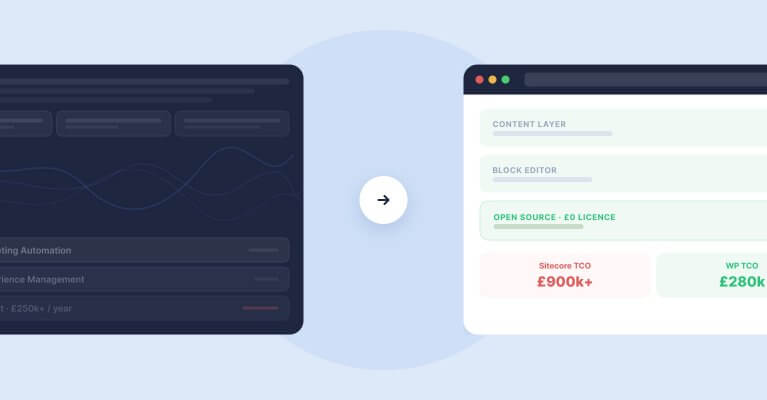
Sitecore to WordPress: What to Expect from the Migration
Your Sitecore contract renewal is approaching and the numbers no longer add up. Before you commit to a migration, here is what actually happens when enterprise teams move from Sitecore to WordPress — the real costs, the content challenges, the SEO risks, and the decisions that separate smooth transitions from expensive false starts.