Your website might rank perfectly well on Google and still be invisible to the millions of people getting answers from ChatGPT, Gemini, Claude, and Perplexity every day. That visibility gap — between traditional search rankings and AI-powered discovery — is exactly what an AI SEO audit is designed to find. An ai seo audit examines how well your website is structured for visibility across large language models and AI search platforms, not just Google.
Your ranking position on Google is no longer the only measure of visibility that matters. The moment someone opens ChatGPT, Gemini, Perplexity, or Claude instead of a search engine, your traditional ranking becomes irrelevant. What those AI platforms show instead depends on a completely different set of signals.
An AI SEO audit finds the gap between those two audiences. It tells you whether your site is visible to the AI platforms that your customers are actually using — and if not, what is blocking it.
What Is an AI SEO Audit?
An AI SEO audit is a structured evaluation of how well your website is positioned for visibility in AI-generated answers, summaries, and citations. It covers the technical, content, and authority factors that large language models use to decide which sources they trust enough to surface.
Where a traditional SEO audit asks “will Google rank this page?”, an AI SEO audit asks “will ChatGPT, Gemini, Perplexity, or Claude cite this content?”. The two questions overlap — but they do not have the same answers.
Research suggests that a significant proportion of AI Overview citations come from pages that rank beyond the top 20 in traditional search. That means good Google rankings do not guarantee AI visibility, and poor Google rankings do not necessarily prevent it. What matters to AI platforms is different: how clearly your content answers a question, how well your entity relationships are established across the web, how authoritative your sources are, and how easily information can be extracted, structured, and attributed to you.
Traditional Audit vs AI SEO Audit
A traditional SEO audit is still valuable — technical health, crawlability, page speed, and on-page optimisation all matter. But it was designed for a world where the goal was to rank in ten blue links. That is no longer the whole picture.
Here is how the two compare:
Traditional SEO Audit Checks
AI SEO Audit Adds
Page speed, Core Web Vitals
Crawler access across ChatGPT, Gemini, Perplexity, Claude
Mobile responsiveness
Content structure for extractable answers
Keyword relevance on-page
Schema markup for AI summarisation
Title tags and meta descriptions
Entity relationships and authority signals
Internal linking structure
Brand visibility across AI platforms
Backlink quality and anchor text
Citation tracking by platform
When someone searches via ChatGPT or Google Gemini, they often get a single synthesised answer, not a list of links. Three to eight brands might be mentioned in that answer. Everyone else is invisible.
A traditional audit will not flag that your robots.txt is blocking GPTBot or Google-Extended. It will not check whether your content is structured with the kind of clear, extractable answers that AI models can summarise. It will not tell you whether ChatGPT even knows your brand exists, or whether it consistently describes you accurately. That is the gap an AI SEO audit fills.
Free LLM AI Optimisation Audit
See how your website performs across ChatGPT, Gemini, Claude, Perplexity, and AI Overviews. Free, instant, and based on 90+ ranking factors.
A thorough AI SEO audit evaluates your website across four interconnected areas. Each one affects how AI platforms discover, interpret, and cite your content.
Crawl Access and Rendering
Before any AI platform can cite your content, it needs to be able to access it. This starts with your robots.txt file — a surprisingly common problem we find in audits. The major AI crawlers each have their own user agents: GPTBot for ChatGPT, Google-Extended for Gemini and AI Overviews, PerplexityBot, ClaudeBot, and others.
If your robots.txt is blocking any of these — even unintentionally, through a blanket rule added during a past security review — those platforms cannot index your content at all. Beyond robots.txt, we assess page speed and Core Web Vitals (slow pages are less likely to be fully crawled), XML sitemap completeness, canonical tag consistency, and whether llms.txt has been implemented — a newer standard that signals to AI platforms which content you want them to use.
Content Structure and Citation Signals
AI platforms extract information from your content and synthesise it into answers. The easier you make that extraction, the more likely your content is to be used. This means: does your content answer questions directly and early? Are headings structured as questions or clear statements that mirror how people search? Do you have a clear summary in the first 300 words?
Lists, tables, and definitions should be used where they help extract key information. Content written in a dense, essay-style format is harder for AI to work with — not because it is low quality, but because AI models need to anchor specific facts and statements to a source. Vague or meandering prose makes that harder. Short paragraphs, direct assertions, and well-structured headings all make your content more useful for AI summarisation.
Schema and Entity Markup
Schema markup gives AI platforms explicit context about your content: what type of content it is, who wrote it, when it was published, what organisation it belongs to, and what questions it answers. Pages with comprehensive Schema.org implementation are significantly more likely to be cited in AI-generated answers.
An AI SEO audit checks whether the right schema types are in place for each page type — Article and Organisation schema on content pages, FAQPage on Q&A content, HowTo on process-driven guides, Product on e-commerce pages — and validates the implementation against Google’s Rich Results Test. We also check your organisation entity markup — the way your brand is described across structured data. If your entity signals are inconsistent (different names, addresses, or descriptions across your site, your Google Business Profile, and third-party sources), AI platforms may not confidently attribute content to you.
Authority and Trust Signals
Experience, Expertise, Authoritativeness, and Trustworthiness — Google’s E-E-A-T framework — has direct relevance to AI visibility. AI platforms prefer sources that are clearly authoritative within their topic area. Are your authors identified by name, with biographical details and verifiable credentials? Does your content demonstrate genuine depth and first-hand experience — not just aggregated information from elsewhere? Are you cited or mentioned by other authoritative sources in your sector?
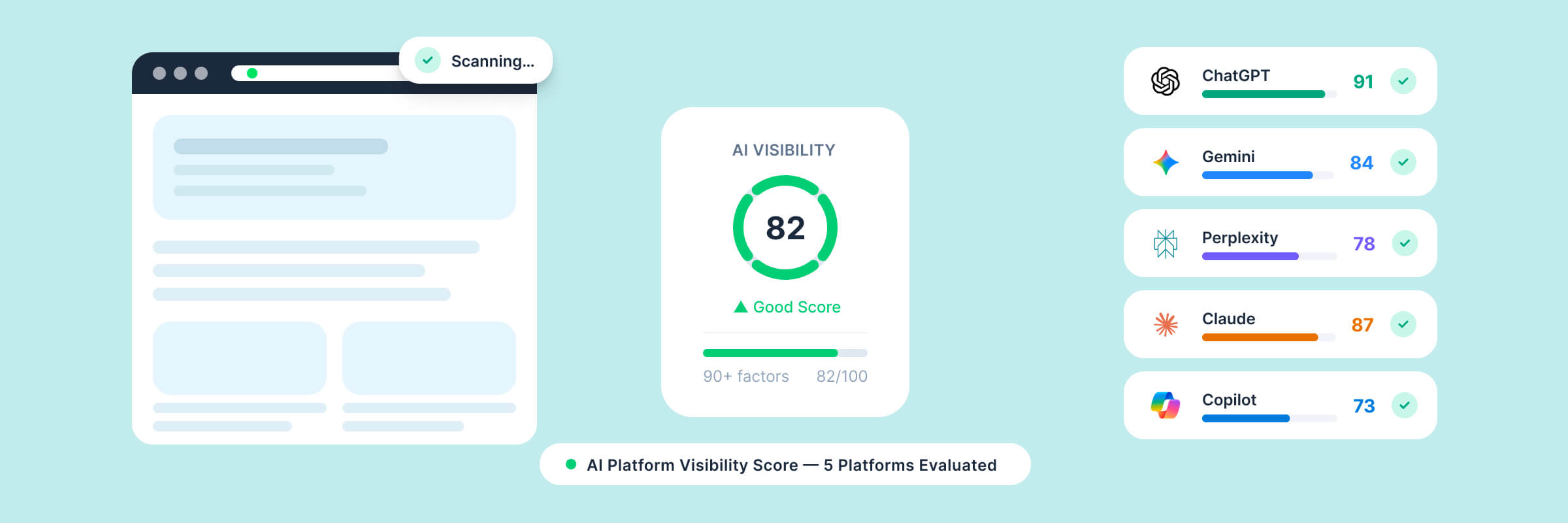
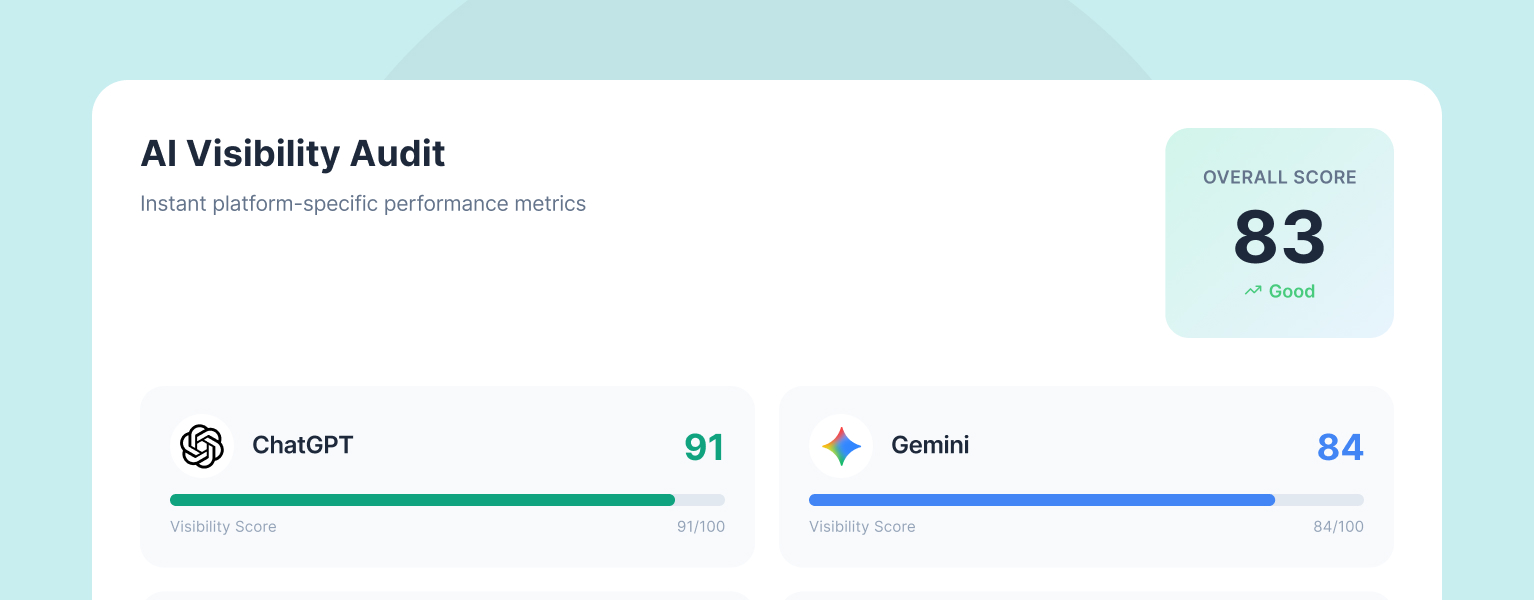
Is your brand entity consistently represented across LinkedIn, Crunchbase, and industry directories? For our clients, we look specifically at whether case studies and thought leadership content demonstrates authentic expertise — not polished copy, but content that reflects real experience, real data, and real results. That is the kind of content AI platforms choose to cite. We also track your brand visibility directly: we query ChatGPT, Google Gemini, Perplexity, Claude, and Bing Copilot with the keywords and questions your target audience is searching, and record what comes back. Is your brand mentioned? Are your pages cited? What are competitors saying? Our LLM AI Optimisation Audit automates this process, scanning over 90 ranking factors and returning an overall score, individual platform scores, and a prioritised action plan.
Where to Start: A Priority-Based Approach
Do not try to fix everything at once. Use this priority framework to sequence your improvements.
Fix These First
Start with the technical blockers. Download your robots.txt file and check for any rules blocking AI crawlers. Look for User-agent: GPTBot, User-agent: Google-Extended, or blanket Disallow: / rules that would catch all bots. If you have a Cloudflare or WAF configuration, check whether AI bot user agents are being challenged or blocked at that layer too. These are quick wins with immediate impact — fix them before anything else.
Then Focus Here
Next, work on your most important pages — the five or ten that matter most commercially. Pick your key service or product pages, your highest-traffic content, and any pages targeting your primary keywords. For each one, assess: does this page give a clear, direct answer to the question it targets within the first 300 words? Are the headings specific and question-like? Is the content broken into scannable sections?
Content that buries the answer three paragraphs down needs restructuring. Use Google’s Rich Results Test or Schema.org Validator to check that Article schema is present on all content pages, Organisation schema is on your homepage, FAQPage schema is on any Q&A sections, and that all markup validates without errors. On WordPress, plugins like Yoast SEO or Rank Math handle much of this automatically, but custom implementations often work better for complex sites.
The Longer Game
E-E-A-T is the longest play. Building genuine topical authority takes time — it means publishing original research, getting cited by other credible sources, ensuring your authors have verifiable profiles, and consistently demonstrating depth across your chosen subject area. There are no shortcuts here. But each new piece of credible, well-structured content you publish compounds over time. Measure impact by revisiting your AI citation check monthly. You want to see whether the changes you are making are translating into more mentions across platforms. We recently wrote about how we connected WordPress to AI using the Abilities API and MCP — that same infrastructure allows us to monitor and improve AI visibility continuously for our clients.
What to Expect From Your Results
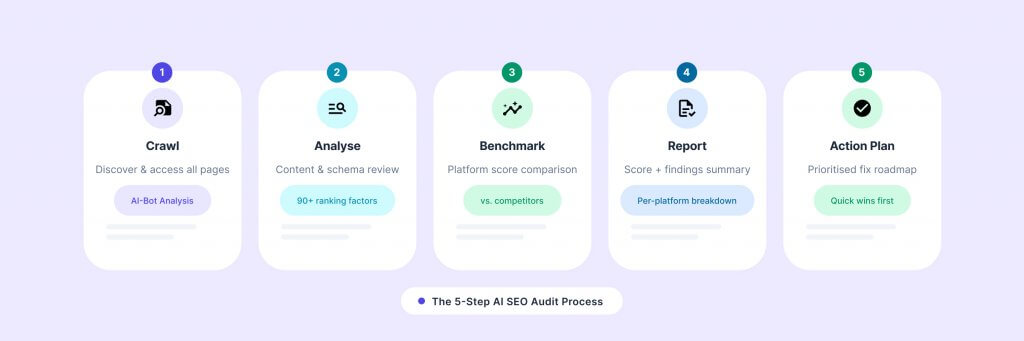
An AI SEO audit should give you three things: an overall readiness score across all platforms, individual scores for each AI platform (ChatGPT, Gemini, Perplexity, Claude, Bing Copilot), and a prioritised action list telling you exactly what to fix first. The report shows you specific technical issues, content gaps, and authority signals that are helping or hurting your visibility.
What it does not do is give you a passive list of problems. A good audit connects each finding to an action — and gives you a way to measure whether your improvements are working. You should be able to re-run the audit monthly and see movement.
What Is An AI Readiness Assessment?
Before auditing your site for AI visibility, understand whether your organisation is ready to act on what you find.
An audit without action is just a list of problems. Our LLM AI Optimisation Audit is built to be actionable. It gives you an immediate baseline — this is where you are right now across each platform — so you can measure whether your improvements work.
For deeper engagement, our SEO and content strategy services take the audit findings and build a specific, sequenced implementation roadmap. We work with your team (or do the work ourselves) to restructure content, implement schema, fix technical blockers, and build topical authority — then track results over time using our AI visibility platform. We also deploy Filter AI (our open-source WordPress plugin for content automation) and PersonalizeWP (our award-winning personalisation platform) to speed up execution.
We are a WP Engine EMEA Agency Partner of the Year and WordPress VIP Silver Partner, with 20+ years building WordPress platforms, 60+ published client stories, and a 4.9/5 rating on Clutch. Run the free audit on your site and we will show you exactly where to focus.
Having worked in agencies since he left university, Paul drives both the technical output at Filter, as well as being responsible for planning. His key strengths are quickly understanding client briefs and being able to communicate complex solutions in a clear and simple manner.
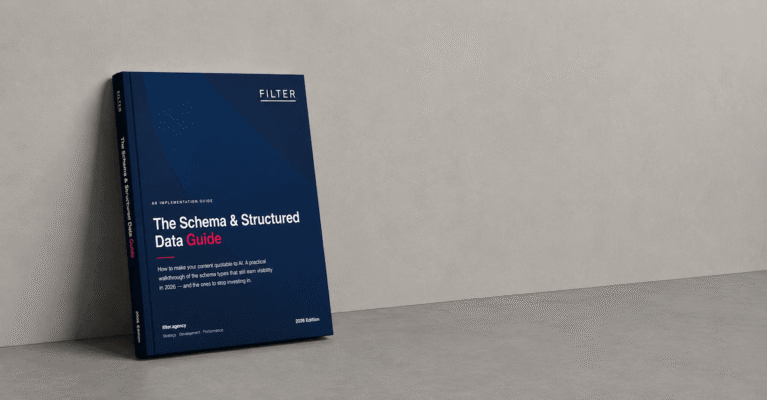
Our guide shows digital leaders and development teams how structured data earns AI citations now that systems like ChatGPT and AI Overviews, not rich results, decide visibility.
Download our practical guide to AI and WordPress, covering the new Abilities API, MCP Adapter and AI Client in core, plus how to prepare your platform for the agentic web.
Sitecore to WordPress: What to Expect from the Migration
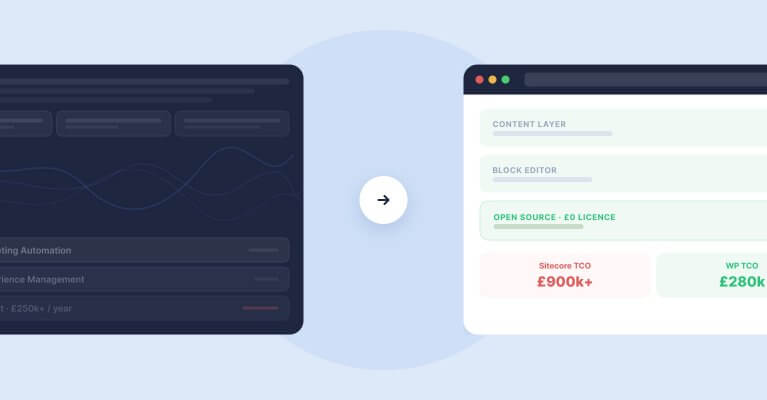
Your Sitecore contract renewal is approaching and the numbers no longer add up. Before you commit to a migration, here is what actually happens when enterprise teams move from Sitecore to WordPress — the real costs, the content challenges, the SEO risks, and the decisions that separate smooth transitions from expensive false starts.