AI Visibility Benchmark Report: How UK Websites Perform Across 6 AI Platforms
20 April 2026 •
8 mins read
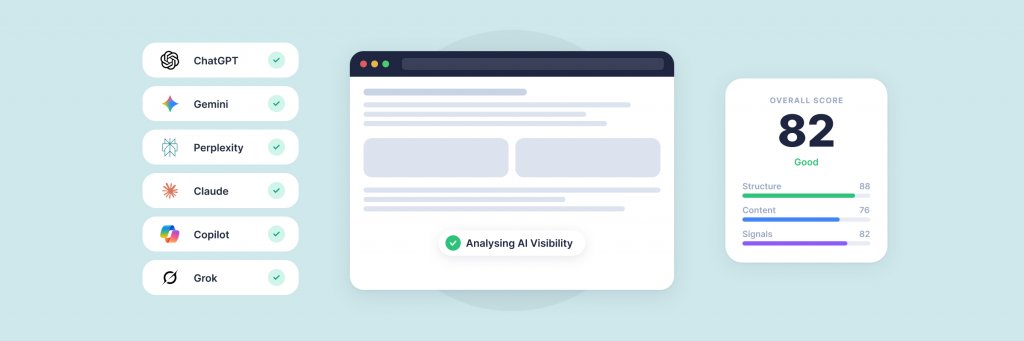
We ran AI SEO audit checks across a set of UK websites — e-commerce brands, professional services firms, hospitality businesses, and media publishers — measuring performance across the six AI platforms now shaping how audiences discover content: ChatGPT, Gemini, Perplexity, Microsoft Copilot, Claude, and Google AI Overviews. This is what we found.
The headline finding: the platforms don’t agree on what to cite. Only 11% of domains cited by ChatGPT also appear in Perplexity results. UK AI platform usage has grown 389% year-on-year, yet most UK websites have been built — at best — for one of the six. This report sets out what each platform rewards, where UK sites are consistently falling short, and what the best performers are doing differently.
AI search is no longer a single channel. ChatGPT holds over 60% of global AI chatbot usage, processing 2.5 billion prompts daily. But the other five platforms are not marginal alternatives — they each reach distinct UK audiences in ways that matter to most businesses.
Google’s Gemini is embedded across Android, Workspace, and Google Search, with Google AI Mode reaching 34% of UK searchers by Q1 2026. Perplexity has surpassed 780 million monthly queries globally. Microsoft Copilot sits inside the 365 ecosystem — Office, Teams, Outlook — giving it direct daily access to millions of professional UK users. Claude is increasingly the tool of choice for research-heavy professional tasks. And Google AI Overviews are now a standard feature across a substantial proportion of UK search results.
Together, these six platforms are where UK audiences are discovering businesses, services, and information. The problem is that most websites have never been evaluated across all of them. And when they are, the results vary dramatically.
Platform by Platform: What We Found
Each platform has distinct sourcing preferences. Analysis of over 6.8 million citations across these platforms reveals consistent patterns — and understanding them is where a well-structured AI visibility strategy starts.
ChatGPT
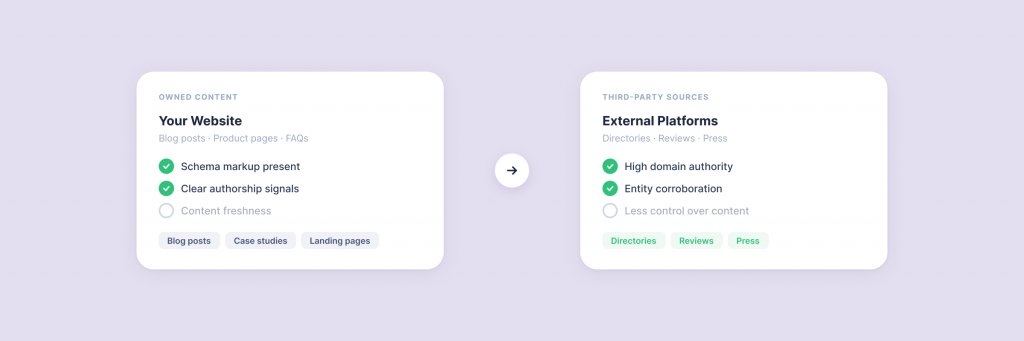
ChatGPT draws heavily on third-party sources. 48.73% of ChatGPT citations come from sites other than the brand being discussed — directories, review platforms, news sources, and knowledge bases like Wikipedia. For UK brands, visibility on ChatGPT is substantially shaped by your presence on Trustpilot, Companies House, industry directories, and specialist press. A well-maintained brand website helps, but it isn’t the primary signal.
The question ChatGPT is effectively asking is: does the rest of the web agree that this business is credible? Brands with a strong third-party footprint consistently outperform those investing only in their own domain.
Gemini
Gemini is the outlier. 52.15% of its citations come directly from brand-owned websites — making it the most responsive platform to improvements you can make on your own domain. Well-structured pages with clear headings, direct answers to common questions, and properly implemented schema tend to perform noticeably better here than on the other five platforms.
The catch is that “structured” has to mean genuinely structured — content built to answer questions, not just long pages broken up with a few headings. Gemini rewards owned content depth and directness in a way the other platforms don’t replicate.
Perplexity
Perplexity sources narrowly, leaning into sector-specific high-authority sources. In hospitality, TripAdvisor dominates. In healthcare, NHS resources and regulatory bodies. In professional services, established trade publications and regulatory organisations carry the most weight. For most UK B2B businesses, industry press matters more to Perplexity than brand-owned content.
This is the platform that most rewards a sustained earned media and directory strategy — and the one where gaps in third-party presence are most directly costly.
Microsoft Copilot
Copilot draws on Bing-indexed content and Microsoft’s knowledge graph. Many UK businesses haven’t given Bing the same attention as Google, and it shows in Copilot performance. Incomplete Bing Places listings, pages not indexed by Bing, and content not formatted for Bing’s crawlers all suppress visibility here.
This matters more than most teams realise. A substantial proportion of UK enterprise, finance, legal, and public sector users operate primarily within Microsoft 365. For those audiences, Copilot visibility is a meaningful commercial priority that most websites haven’t addressed.
Claude
Claude takes a conservative approach. It prioritises content from domains with demonstrated authority and factual depth — long-form, well-cited material that can be cross-referenced across multiple signals. UK brands performing well here tend to have substantive content: articles that reference data, commentary that cites sources, and service pages with genuine explanatory depth.
Thin, conversion-led copy performs poorly. If your website is built primarily to generate leads rather than provide information, Claude is likely underserving you in ways you haven’t measured.
Google AI Overviews
Of the six, AI Overviews shows the strongest correlation with traditional search rankings. Sites in positions one to ten for a given query are significantly more likely to appear in AI Overviews than lower-ranked competitors. But correlation isn’t causation — content structure matters independently. Pages formatted to answer questions directly, with concise answers early in the body, consistently outperform ranking peers that aren’t structured for extractability.
The practical implication: AI Overviews rewards good SEO, but good SEO alone is no longer sufficient.
Cross-Platform Patterns Worth Noting
With the platform-level picture in place, three cross-cutting patterns emerge consistently across the UK sites we evaluated.
Citation overlap is lower than most expect. That 11% figure between ChatGPT and Perplexity is striking because it means that almost nine in ten ranking opportunities are platform-specific. Strategies that treat AI search as a single channel — optimising for one platform and assuming gains transfer — will underperform systematically. The brands with strong multi-platform visibility have invested across several fronts: structured owned content, third-party presence, directory accuracy, and consistent earned media coverage.
Domain churn is high and ongoing. Around 50% of domains cited across these platforms shift month to month. This isn’t the relatively stable citation landscape of traditional backlinks — AI platforms update what they surface based on new content, new sources, and model updates. A one-off audit captures a moment in time; ongoing monitoring shows whether interventions are working and flags when position changes.
UK brands lag behind US counterparts. At equivalent domain authority levels, UK sites consistently underperform US brands across most platforms. The reason is largely structural: US businesses have invested earlier and more heavily in the directory, review, and editorial presence that forms the third-party backbone of AI citations. The gap is closeable — but it requires sustained investment in earned presence, not just better on-site optimisation.
Free LLM AI Optimisation Audit
See how your website performs across ChatGPT, Gemini, Claude, Perplexity, and AI Overviews. Free, instant, and based on 90+ ranking factors.
AI visibility patterns break down consistently along sector lines.
Professional services — law, finance, consulting — perform above average across most platforms. Content in this sector tends to be long-form, technical, and frequently cited in specialist publications: a combination that works well for ChatGPT, Perplexity, and Claude in particular. The weak spot is typically Gemini. Professional services content is often structured around demonstrating expertise rather than directly answering common questions, which limits extractability for Gemini’s answer-led responses.
Media and publishing organisations are the structural winners of AI search. Regular publication cadence, authoritative sourcing, and content built to be scanned and extracted performs well across all six platforms. Many publishers see AI search primarily as a traffic threat — which it may be — but they’re better positioned technically than almost any other sector.
E-commerce is struggling. Large product catalogues with thin descriptions — the standard pattern for many UK retailers — perform poorly across all six platforms. Missing Product schema, sparse attribute data, and thin category pages create systematic visibility gaps. For more on how AI is changing the e-commerce discovery landscape, our piece on how AI is changing online retail covers the commercial picture in depth.
Hospitality faces a specific structural challenge: OTAs and booking platforms dominate AI citations in the travel sector, making it difficult for brand-owned hotel and venue websites to appear ahead of TripAdvisor or Booking.com regardless of how well structured they are. Our guide on how hotels and hospitality brands can use AI to get found covers the tactics that work within those constraints.
What Well-Performing UK Sites Have in Common
The sites doing well across multiple platforms don’t share a sector, size, or technology stack. They share a structural profile.
Schema implementation is comprehensive — not just Organisation markup on the homepage, but Product, Service, FAQ, and Article schema applied consistently across the relevant page types. AI crawlers can extract structured answers rather than having to interpret unstructured prose. Filter AI, our open-source WordPress plugin, handles schema generation and content quality work at scale: structured metadata, alt text, and FAQ schema across large content sets without requiring manual work on individual pages.
AI crawlers are unblocked — intentionally and verifiably. GPTBot, ClaudeBot, PerplexityBot, and Google’s crawlers can all access the site. Robots.txt files are reviewed regularly. CDN and security configurations don’t inadvertently sweep them into broad bot-blocking rules — a more common accidental issue than most teams realise.
Third-party presence is consistent and current. The same business name, address, and contact details appear accurately across Google Business Profile, Bing Places, Trustpilot, Companies House, and relevant industry directories. Review profiles are actively maintained. The brand appears in a range of editorial sources — not just press releases, but cited mentions in relevant publications and genuine sector commentary.
And core content has genuine depth. Key pages answer questions directly and fully — not a paragraph of marketing copy, but the kind of detail a careful prospective client would need to make a decision. That content is structured with headings and sections an AI can navigate, with direct answers early in the page rather than buried at the end.
Running Your Own AI SEO Audit
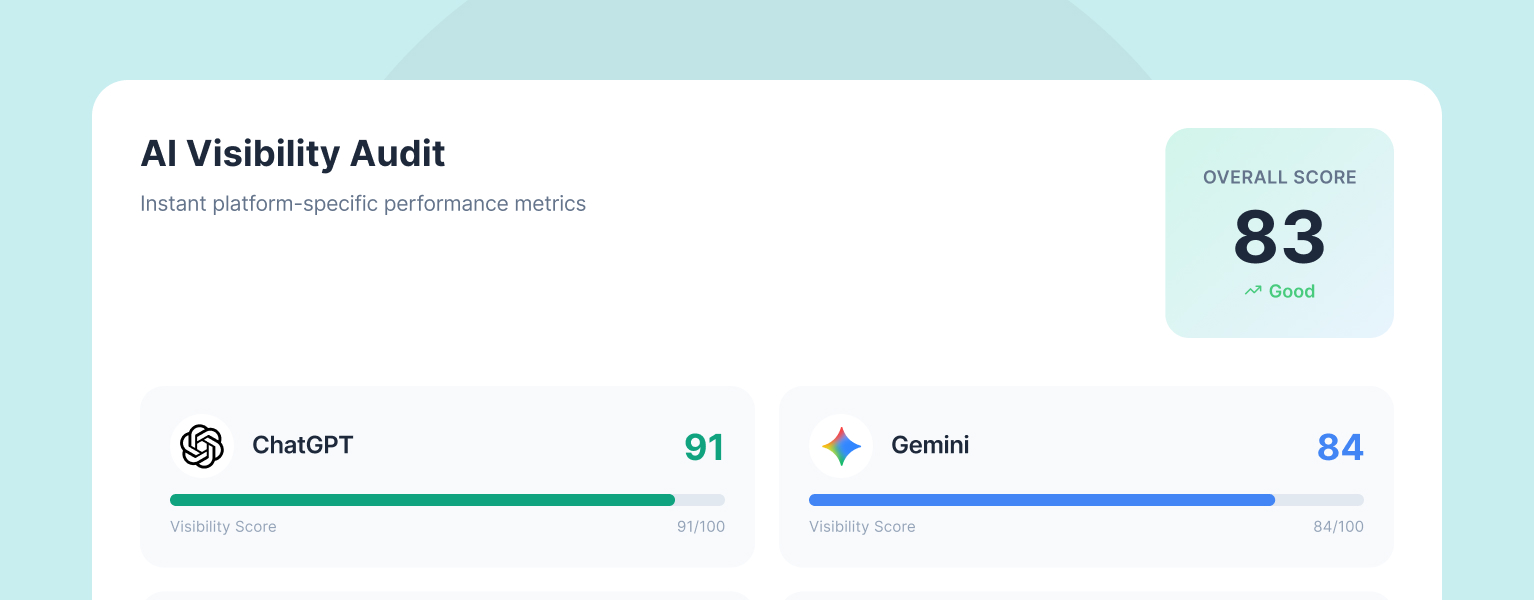
An AI SEO audit looks at your site’s performance across all six of these platforms — not just one. Filter’s free LLM AI Optimisation Audit evaluates your visibility across ChatGPT, Gemini, Perplexity, Copilot, Claude, and Google AI Overviews, identifying where you’re appearing, where you’re not, and what’s driving the gap.
The audit covers four areas: technical access (whether AI crawlers can reach and index your site), structured data (what schema you have and what’s missing), content quality (whether your pages can answer questions in an extractable format), and third-party footprint (your presence across the external sources each platform draws on). For a detailed breakdown of the methodology, our article on what an AI SEO audit covers goes through each area in practical detail.
The benchmarks in this report reflect patterns we see consistently across UK website audits. To understand where your site sits relative to them — or to discuss what AI visibility looks like for your sector specifically — get in touch or run the free audit to start with.
The Definitive Guide to Generative Engine Optimisation
Understand the full framework behind AI search visibility — how platforms discover and cite content, how GEO differs from SEO, and how to build a strategy that works across all the platforms that matter.
Having worked in agencies since he left university, Paul drives both the technical output at Filter, as well as being responsible for planning. His key strengths are quickly understanding client briefs and being able to communicate complex solutions in a clear and simple manner.
Our guide shows digital leaders and development teams how structured data earns AI citations now that systems like ChatGPT and AI Overviews, not rich results, decide visibility.
Download our practical guide to AI and WordPress, covering the new Abilities API, MCP Adapter and AI Client in core, plus how to prepare your platform for the agentic web.
Sitecore to WordPress: What to Expect from the Migration
Your Sitecore contract renewal is approaching and the numbers no longer add up. Before you commit to a migration, here is what actually happens when enterprise teams move from Sitecore to WordPress — the real costs, the content challenges, the SEO risks, and the decisions that separate smooth transitions from expensive false starts.