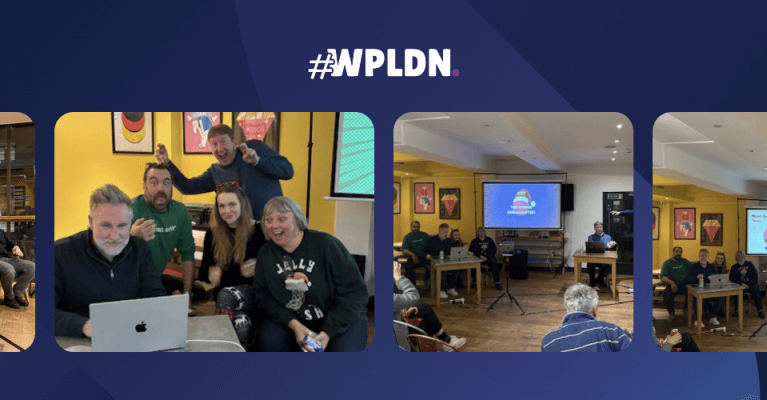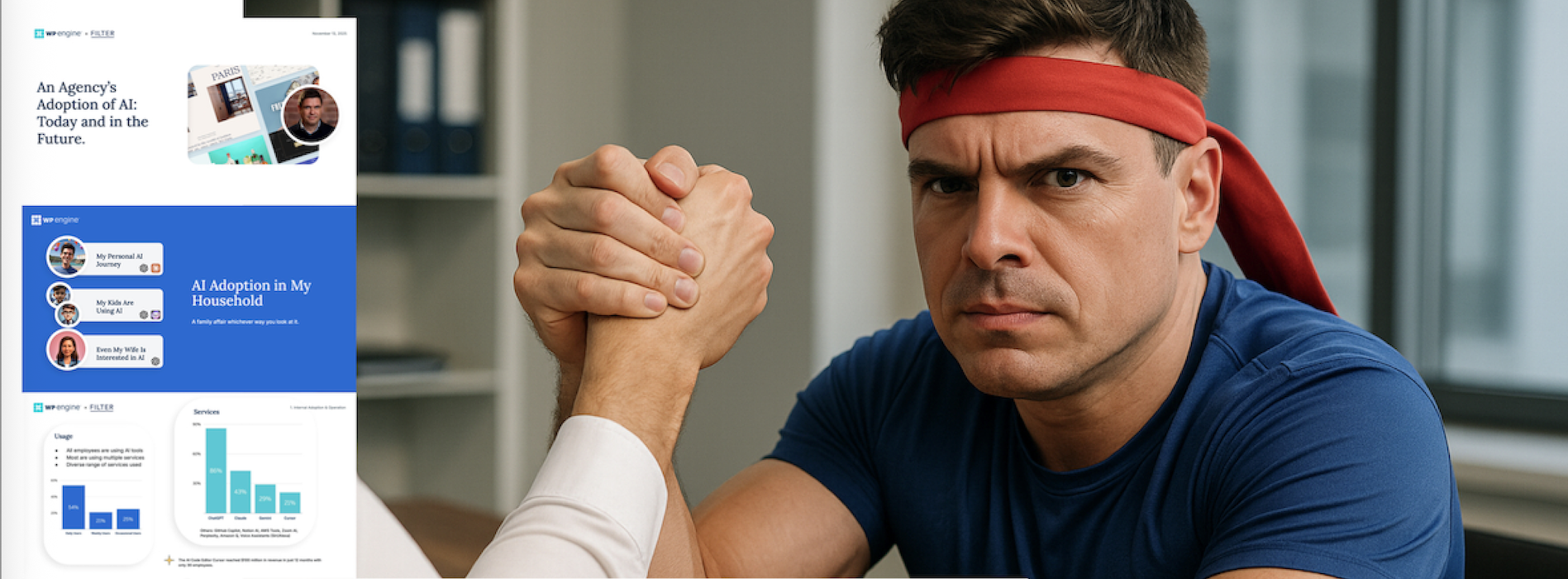
Last week, WP Engine brought together agency leaders and industry experts for their Agency Partner Insights event.
The afternoon explored how agencies are navigating AI adoption through a series of presentations and a panel discussion:
Whilst preparing my session, something struck me: we’re all talking about “AI adoption” as if it’s a future decision we need to make. But AI isn’t something we’re adopting anymore. It’s already woven into the fabric of our daily lives.
I’ve always been confused about which hand does what. I write left handed, kick a ball with my left foot, but throw right handed. I play pool left handed, cricket right handed. Turns out I’m cross dominant, where different tasks inexplicably use different hands or feet.
And that’s exactly where most of us are with AI right now. Trying different tools for different jobs, not entirely sure if we’re using the right approach, switching between services based on instinct rather than strategy.
Even in my household, the adoption has been surprisingly organic. I started with ChatGPT in late 2023 for basic writing tasks. By February 2024, I was using it to plan our family trip to Valencia. My kids were generating playful images with Apple’s Image Playground and redesigning the garden. My wife, who’s never consciously used ChatGPT, is designing music studio concepts with DALL-E.
The point is: AI isn’t coming. It’s here. We’re already using it over 100 times a day through autocorrect, navigation routes, spam filters, and Netflix recommendations.
Our internal adoption has been revealing. We recently surveyed our team and found that every single employee is using AI tools. Not some. All. 54% use them daily, with ChatGPT leading at 86% adoption, followed by Claude at 43%.
The use cases tell the real story: documentation and writing, content creation, code development, research and learning. One team member summed it up perfectly: “What used to take an hour now takes 5 minutes.”
But the challenges are real too. Prompting and context remain difficult. Accuracy concerns persist. Everything needs verification. And yes, hallucinations happen, where AI confidently provides completely incorrect information.
We’ve built our own open-source WordPress plugin, Filter AI, which lets users generate SEO-friendly content, alt tags, and WooCommerce product descriptions whilst choosing their preferred AI service (Claude for writing, Gemini for images, whatever works). Because real expertise comes from building tools, not just using them.
This feels like a gold rush, and everyone’s rushing to stake their claim. But here’s what’s worth remembering: in the California Gold Rush, it wasn’t the prospectors who made money. It was the people selling shovels.
As agencies, we’re in the shovel-selling business. We help clients use these tools effectively. That requires deep understanding, not just rapid adoption.
So yes, experiment aggressively. Try things. Break things. Learn constantly. But adopt thoughtfully, not desperately.
The agencies that survive won’t be the ones with the most AI tools. They’ll be the ones who work out what humans should actually be doing when AI handles the execution.
Here’s what keeps me up at night: we’re caught in what I’m calling the Speed Paradox.
Technology accelerates exponentially. Human adaptation stays linear. That gap creates both extraordinary opportunity and absolute chaos.
And here’s where it gets uncomfortable. Code, in some instances, is becoming commoditised. Execution is becoming abundant (the very thing that was always hard to do). Speed is no longer a differentiator. Time and materials pricing? Probably dying, certainly adapting.
So what becomes valuable when execution becomes cheap? Strategic judgement and patience. Curatorial taste. Deep client understanding. Relationships.
These capabilities can’t be automated. But they can be cultivated. And right now, most agencies haven’t actually developed them because they’ve been too busy executing.
The truth is, most agencies have been selling technical capability whilst calling it strategy. That stops working now.
WordPress 7.0 is coming with core AI features. MCP Servers will enable deeper platform integration. Intelligence will be embedded, not optional. Content will adapt in real time. Every visitor will get a unique experience.
The agency value proposition has evolved three times in my career. From “we build websites” in the 1990s and 2000s, to “we orchestrate digital experiences” in the 2010s and 2020s. Now we’re entering the third era: “we architect embedded, self-improving digital experiences.”
The platforms are intelligent now. Content doesn’t just sit there once published, it adapts. Interfaces adjust. Experiences personalise automatically. You’re not building finished products anymore. You’re architecting systems that learn and improve themselves.
The question isn’t whether this is coming. It’s whether you’ll be ready when it arrives. And whether you’ve spent this transition period developing the genuinely strategic capabilities that matter when execution becomes abundant.
CEO & Founder
An experienced business and digital leader, Olly has an extensive track record of working to develop businesses through smart strategic thinking. With a strong reputation for providing outstanding solutions, he’s an advocate for exacting standards and focusing on performance outcomes.

Filter’s Co-Founders Selected as BIMA 100 Judges for 2026
We are proud our co-founders will judge the 2026 BIMA 100, celebrating the UK’s top digital talent. This reflects our commitment to the digital community and our deep expertise in engineering scalable digital platforms that deliver measurable, transformative business outcomes for our trusted client partners.
853 Miles to Alicante: How Filter Walked (and Rowed, and Cycled) for Great Ormond Street Hospital Charity
To mark a client’s expansion, our team collectively walked, rowed, and cycled the 810-mile distance to Alicante. We surpassed our goal, covering 853 miles and raising vital funds for Great Ormond Street Hospital. This challenge shows our commitment to collaboration and achieving measurable, impactful outcomes.